PART 1
The chandelier above my parents’ dining table had always felt like a weapon — too large, too bright, casting sharp fragments of light across faces that had spent decades learning exactly how to look at me with pity and amusement. Tonight was no exception. The air was thick with the smell of rosemary-crusted lamb, aged Bordeaux, and the quiet arrogance that only old Virginia money could perfect.
I sat at the far end of the long mahogany table in a simple black dress, the same one I had worn when I pinned on my third star. My sister Vanessa was holding court as usual, her voice carrying that practiced sharpness she used whenever she wanted to remind everyone how successful she was. My brother Marcus kept refilling glasses with the confidence of a man who had never once doubted his place in the world. At the head of the table, my father, Richard Lockridge, presided like a king who had never lost a battle.
They had an important guest tonight — Dr. Alan Whitmore, a prominent cardiac surgeon my father was courting for a hospital board seat. That was the only reason I had been invited. My mother had made it very clear on the phone: “Be pleasant, Riley. Don’t make it weird.”
So I sat quietly, listening to the familiar symphony of my own erasure.
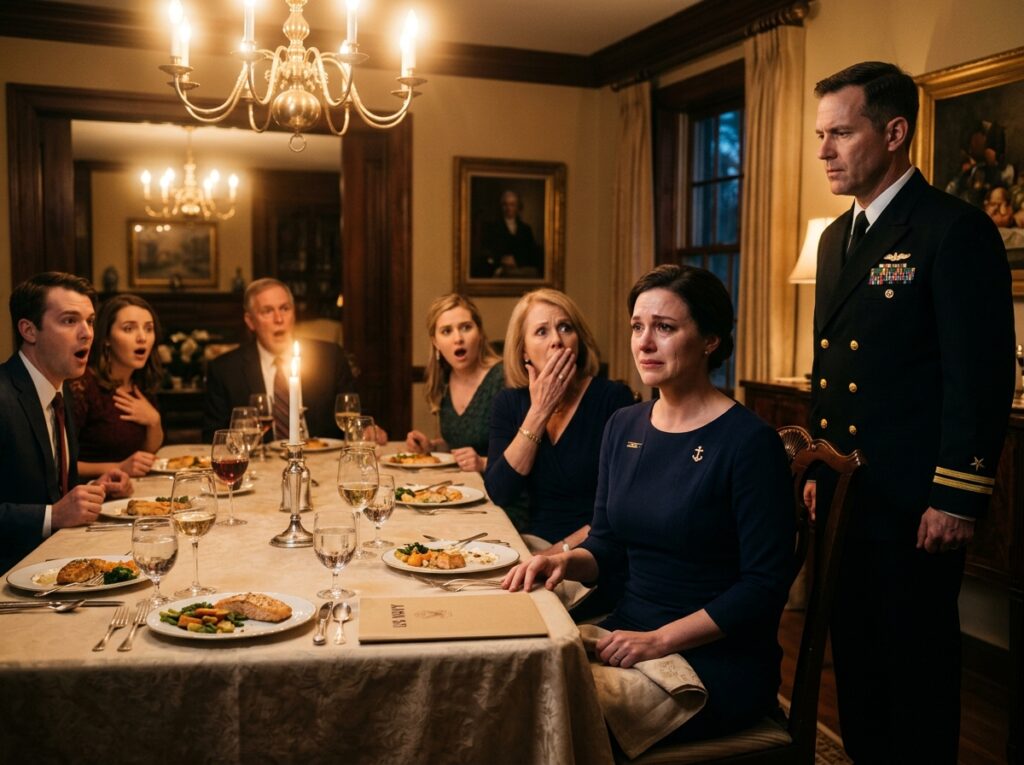
Vanessa leaned toward Dr. Whitmore with a theatrical sigh. “Poor Riley. She used to do laundry on base, you know. Folding uniforms for actual soldiers. It was her little phase after high school. We all hoped she’d grow out of it, but… well, here we are.”
Marcus laughed into his wine. “Remember when she came home in that ridiculous camouflage and told us she was ‘deploying’? Dad almost called the authorities. Thought she’d joined some survivalist group.”
My father gave that indulgent chuckle he had perfected over thirty-eight years. “Riley’s always had a vivid imagination. We humored her. But let’s be honest — laundry duty was probably the most honest work she ever did in that uniform phase of hers.”
The table erupted in soft, polite laughter. The kind that had followed me my entire adult life.
I said nothing.
Instead, I reached down, picked up the crisp linen napkin from my lap, and folded it slowly — once, twice, three times — smoothing every edge with deliberate, military precision. The fabric felt cool and familiar against my fingers. I placed it neatly beside my plate.
Not a single word left my mouth.
Five minutes later, the doorbell rang.
My mother frowned. “We’re not expecting anyone.”
The housekeeper opened the door. Low voices carried down the hallway. Then came the unmistakable sound of dress shoes on marble — measured, authoritative steps.
A tall man in full Navy dress whites appeared in the dining room doorway. Four silver stars gleamed on each shoulder. Two aides stood respectfully behind him.
The entire table went still.
The Rear Admiral’s eyes swept the room once before locking directly onto me. He came to full attention and saluted crisply.
“Rear Admiral Lockridge, ma’am,” he said, voice clear and carrying. “Vice Chief of Naval Operations. I apologize for interrupting your evening, but we have a developing situation in the South China Sea. The Secretary of Defense is holding for your decision, Admiral.”
The room fell into a silence so complete I could hear the ice shifting in the crystal glasses.
Vanessa stopped breathing mid-laugh, her mouth frozen open. Marcus’s wine glass hovered halfway to his lips, red liquid trembling. My father’s face drained of all color.
I stood slowly, returned the salute with calm precision, and said, “Thank you, Admiral Hayes. Tell the Secretary I’ll take the call in the study. Five minutes.”
He nodded sharply. “Yes, ma’am.”
As the three officers stepped back into the hallway, the silence exploded.
My sister finally gasped for air. “What… the actual fuck… was that?”
PART 2
The silence that followed was heavier than any combat zone I had ever been in.
Dr. Whitmore looked like someone had just told him the hospital was on fire. My mother’s hand was frozen on her wine glass, knuckles white. Vanessa’s perfectly contoured face had gone slack, her eyes wide with something between shock and horror.
Marcus was the first to find words, though they came out strangled. “Riley… what the hell is going on?”
I didn’t answer immediately. I simply buttoned the single button on my black dress jacket — a small, automatic motion I had done thousands of times — and looked at my father.
He was staring at me as if I had grown a second head. The man who had spent nearly four decades calling me delusional, lazy, and embarrassing was now looking at me like I was a stranger who had broken into his house.
I let the silence stretch for three full seconds.
Then I spoke, my voice calm and level, the same tone I used in the Situation Room.
“Admiral Hayes is correct. I am Rear Admiral Riley J. Lockridge, United States Navy. Current Deputy Commander of U.S. Indo-Pacific Command. I apologize for the interruption to your dinner.”
My sister made a sound — half laugh, half choke.
“You’re lying,” she whispered. “This is another one of your games. You’re not… you can’t be…”
I looked at her directly. For the first time in years, I didn’t soften my gaze.
“Vanessa, I stopped playing games the day I took command of my first destroyer squadron. That was twelve years ago.”
My father’s chair scraped back as he stood up suddenly. “This is ridiculous. Riley, what kind of stunt is this? You expect us to believe—”
The door to the hallway opened again. Admiral Hayes stepped back in, this time holding a secure phone.
“Ma’am,” he said respectfully, “the Secretary is on the line. He says it’s urgent.”
I nodded and took the phone. “Mr. Secretary… yes, sir. I understand. Give me the latest from PACOM… Yes, I concur with the recommendation. Authorize it.”
I handed the phone back to Hayes. He saluted once more and left.
When I turned back to the table, my family looked like they had been hit by a missile.
My mother’s eyes were filled with tears — not of pride, but of something far more complicated. Recognition. Regret. Fear.
My father’s mouth opened and closed twice before any sound came out.
“You… you’re really…?”
“Rear Admiral,” I finished for him. “Three stars. Thirty-eight years of service. Nineteen deployments. Command of two carrier strike groups. And yes, Father — I have never done laundry on base. I oversaw the entire logistics chain for Seventh Fleet.”
Vanessa’s face had gone from pale to blotchy red. “This is insane. You’re telling us you’ve been some big-shot admiral this whole time and never said anything?”
I looked at her with the kind of calm that only comes after years of being dismissed.
“I told you. Many times. You all chose not to believe me.”
PART 3
The silence that followed my words was not empty — it was suffocating, thick with decades of disbelief, mockery, and buried shame. Every person at that table was staring at me as if I had just stepped out of a nightmare they couldn’t wake from.
My father’s face had gone from pale to a sickly gray. The man who had spent his entire life controlling the narrative of our family now looked like someone had ripped the script from his hands and burned it in front of him. His mouth opened, but no sound came out at first. When it finally did, his voice was hoarse, almost broken.
“Riley… this isn’t funny. Stop this right now.”
I met his eyes without flinching. Thirty-eight years of being called delusional, lazy, attention-seeking, and embarrassing had forged something cold and unbreakable inside me.
“I stopped trying to be funny to you the day I took command of my first ship, Father. That was fourteen years ago. You just never cared enough to listen.”
Vanessa’s hands were shaking so badly she had to grip the edge of the table. Her perfect makeup, usually flawless for these performances, now looked like a cracked mask. “You’re lying,” she whispered again, but this time there was real panic in her voice. “You have to be lying. We would have known. Someone would have told us.”
I almost smiled, but there was no warmth in it.
“You mean the way I told you? Every time I came home on leave? Every time I sent photos from the bridge of a destroyer? Every time I mentioned deployments to the Persian Gulf, the South China Sea, the Mediterranean? You all laughed. You called them ‘Riley’s little stories.’ You told your friends I was ‘still playing soldier.’”
My mother made a small, wounded sound from the other end of the table. Her eyes were glistening with tears that hadn’t fallen yet. For the first time in years, I saw something real break across her face — not the practiced social smile she always wore, but genuine, crushing regret.
“Riley…” she breathed. “Oh God… all those times you tried to show us your uniform… the medals… I thought your father was right. I thought you were… exaggerating.”
Dr. Whitmore sat frozen, his fork still hovering over his plate, looking like he had accidentally walked into someone else’s war.
Marcus finally found his voice, though it cracked halfway through. “If this is true… why didn’t you say anything? Why let us believe you were… nothing?”
I looked at my brother — the golden child, the one who had never once had to fight for respect in this house.
“Because every time I tried, you turned it into entertainment. Because the more I succeeded, the more you needed to tear it down to protect your own egos. Because after a while, it became easier to let you believe I was a failure than to keep smashing my head against the wall of your denial.”
My father slammed his hand on the table suddenly, making the silverware jump.
“This is absurd!” he roared, but the roar was hollow, cracking at the edges. “You expect us to believe you’re a Rear Admiral? You? The girl who could barely keep a job at the mall?”
I didn’t raise my voice. I didn’t need to.
“Father, I have commanded strike groups with more firepower than most countries possess. I have briefed Presidents. I have stood on the deck of an aircraft carrier while fighter jets launched into combat. And right now, while we’re standing here, American sailors are waiting for my orders in waters that could ignite into war tonight.”
I turned to Admiral Hayes, who had remained standing respectfully near the doorway.
“Admiral, please inform the Secretary that I will join the secure call from the study in two minutes. And tell him the family situation has been… clarified.”
Hayes saluted sharply. “Yes, ma’am.”
As he left, the tension in the room became almost unbearable. Vanessa was crying now — not the elegant tears she used for sympathy, but ugly, gasping sobs that shook her shoulders.
“You let us humiliate you,” she choked out. “All these years… at every dinner, every gathering… we laughed at you. And you just… sat there?”
I looked at her for a long moment.
“No, Vanessa. I didn’t ‘let’ you. You chose to be cruel. I chose to survive it.”
My father was still standing, breathing hard, his perfect world collapsing around him in real time. For the first time in my life, I saw fear in his eyes — real fear. Not of me as his daughter, but of what I had become. Of the power I carried. Of the truth he could no longer bury.
“Riley,” he said, his voice suddenly small. “If this is true… why didn’t you ever force us to see it?”
I picked up the folded napkin again, holding it like a shield I no longer needed.
“Because some truths are so big, the people who refuse to see them don’t deserve them. Not until the universe forces their eyes open.”
I turned toward the study door.
“Now if you’ll excuse me, I have a war to help prevent.”
PART 4
I walked out of the dining room without looking back, my heels clicking steadily on the marble floor — the same measured gait I used when walking across the flight deck of a carrier at 2 a.m. Behind me, chaos erupted like a delayed explosion.
Vanessa’s voice rose into a hysterical pitch. “This isn’t real! It can’t be real! She’s lying, Dad — she has to be lying!”
My father’s roar followed me down the hallway. “Riley! Get back here right now! We are not finished!”
But I kept walking.
The study door closed behind me with a soft, final click, cutting off their voices like a guillotine. Admiral Hayes was already waiting, secure laptop open on the antique desk my father loved so much. He stood at attention until I motioned for him to sit.
“Status?” I asked, voice shifting instantly into command mode.
“Two Chinese destroyers have moved into the exclusion zone near the Spratlys, ma’am. PACOM is requesting ROE clarification. The Secretary wants your personal assessment before he briefs the President.”
I took the seat behind the desk — the same desk where my father used to lecture me about “getting a real job” — and entered my credentials. For the next twelve minutes, the room filled with the language I had lived and breathed for nearly four decades: coordinates, threat vectors, rules of engagement, satellite imagery, and the quiet weight of decisions that could ignite or prevent war.
When I ended the call, Admiral Hayes closed the laptop and looked at me with the respect of one professional to another.
“They’re lucky to have you, ma’am. Especially tonight.”
I allowed myself the smallest exhale. “Thank you, Tom. Drive safe back to D.C.”
He hesitated at the door. “For what it’s worth… I’ve seen a lot of families over the years. Not many could have carried what you just carried in that dining room.”
I nodded once. He saluted and left.
The silence that followed was heavier than any combat zone I’d ever known.
When I finally stepped back into the dining room, the scene had completely transformed. No one was eating. The lamb had gone cold. Wine glasses sat untouched. My family looked like survivors of a shipwreck.
My mother was crying openly now, silent tears streaming down her face. Vanessa’s mascara had run in black rivers. Marcus stared at the table like it had personally betrayed him. And my father — the great Richard Lockridge — sat slumped in his chair, staring at me as though seeing a ghost.
I remained standing.
“You wanted the truth,” I said quietly. “Here it is.”
I reached into my small clutch and pulled out my official military ID. I tossed it onto the center of the table. The gold-embossed eagle and my rank caught the light from the monstrous chandelier.
Rear Admiral Riley J. Lockridge. United States Navy. Deputy Commander, U.S. Indo-Pacific Command.
Vanessa picked it up with trembling fingers. She stared at it for a long moment, then looked up at me, her voice barely a whisper.
“You’ve had this… this power… this life… the whole time?”
“Yes.”
My father’s voice came out cracked and raw. “Why didn’t you tell us?”
I laughed — a short, bitter sound that echoed in the silent room.
“I did, Father. I told you when I graduated from the Naval Academy. I told you when I made Lieutenant Commander. I told you when I commanded my first ship. I told you when I received my first star. Every single time, you smiled, patted my head, and told your friends that your daughter was ‘still playing dress-up.’”
Tears were falling freely from my mother’s eyes now. “I believed him,” she whispered. “God help me… I believed him.”
I looked at her — the woman who had once tucked me in bed and told me I could be anything. The same woman who had slowly let my father rewrite my entire existence.
“I know you did, Mom. That’s what hurts the most.”
Marcus finally spoke, his voice thick. “So all those times we laughed… all those jokes about you folding laundry… all those times Dad introduced you as ‘the one who never quite made it’…”
“Were lies,” I finished for him. “Lies you all chose to believe because the truth was too uncomfortable. Because admitting I had surpassed every expectation you had for me would have meant admitting how small and cruel you had been.”
Vanessa covered her face with both hands. “We humiliated you. In front of friends. In front of family. For years.”
“Yes.”
My father stood up slowly, his legs unsteady. The powerful man who had built an empire and controlled everyone in this house now looked old and fragile.
“Riley… I… I don’t know what to say.”
For the first time in my life, I saw genuine tears in his eyes.
But I had waited too many years for those tears.
I looked at all of them — my family, the people who were supposed to love me most — and felt something inside my chest finally settle into place.
“You don’t have to say anything,” I said quietly. “The time for words passed a long time ago.”
I picked up my ID from the table and slipped it back into my clutch.
“I have a plane to catch at 0600. There’s a war that doesn’t care about family dinners.”
As I turned to leave, my mother’s broken voice stopped me.
“Riley… please. Don’t go like this.”
I paused at the doorway, back straight, shoulders squared — the posture of a woman who had earned every star on her shoulder the hard way.
I looked at her one last time.
“You made your choice years ago, Mom. You chose comfort over truth. Now you get to live with it.”
Then I walked out of that house without looking back.
PART 5 (Final Part)
The drive back to Washington that night felt longer than any transoceanic flight I had ever taken.
I sat in the back of the Navy sedan, watching the Virginia countryside blur past in streaks of darkness and occasional porch lights. Admiral Hayes had offered to fly me back on a military jet, but I declined. I needed the silence. I needed the hours to let everything settle inside my chest.
For thirty-eight years, I had carried their disbelief like shrapnel buried deep under my skin. Tonight, it had all been pulled out in one brutal evening — raw, bleeding, and finally exposed to air.
My phone had been vibrating nonstop since I left the house.
Vanessa: Riley please call me. I’m so sorry. I didn’t know.
Marcus: I feel sick. We were monsters.
Mom: I failed you as a mother. I will never forgive myself.
And then, at 2:17 a.m., a single message from my father.
Dad: I don’t know who you are anymore. But I know I helped destroy the person you tried to show us. I’m sorry.
I stared at that message for a long time before typing back three words:
Me: Too late.
I turned my phone off.
Two weeks later, I stood on the bridge of the USS Abraham Lincoln somewhere in the Western Pacific, the salt wind whipping across my face as the sun rose blood-red over the horizon. Three stars glittered on each shoulder. Sailors moved with purpose around me. The weight of command felt comforting — familiar, honest, clean.
My mother had called every single day since that dinner. I answered only once.
She cried for twenty straight minutes, apologizing for every dinner, every joke, every time she had stayed silent while my father erased me. She told me she had confronted him. She told me Vanessa had moved out of the family home. She told me Marcus had started seeing a therapist.
I listened quietly.
When she finally asked if I could ever forgive them, I gave her the only truth I had left.
“Mom, I forgave you years ago. What I can’t do anymore is let you back into my life. Some doors, once closed properly, stay closed.”
She sobbed harder, but she didn’t argue.
My father never called.
Six months later, I received a small package at my headquarters in Hawaii.
Inside was my old commissioning portrait — the one from twenty years ago when I was a fresh ensign with nervous eyes and hope in my smile. The black marker that once said “Pretending” across my face had been carefully erased. In its place, in my father’s shaky handwriting, were new words:
“I was wrong. I’m proud of you. I’m sorry.”
Tucked beneath it was a single sheet of paper — a handwritten letter.
Riley,
I spent my whole life trying to protect an image of our family that was never real. I was cruel because your success terrified me. It made me feel small. I turned you into a joke so I wouldn’t have to face the truth: that you became greater than anything I could ever dream.
I lost my daughter the day I chose my pride over your truth.
If you ever read this, know that I finally see you. Not the girl I tried to create, but the woman you fought to become.
— Dad
I read the letter three times on the balcony of my quarters, the ocean stretching endlessly before me.
Then I folded it carefully, placed it back in the box, and put the box on the shelf next to my medals and citations.
I didn’t cry.
Some wounds heal clean. Others leave scars that remind you never to forget the pain.
I had earned every star on my shoulder. I had earned the respect of thousands of sailors. I had earned the right to decide who sat at my table.
And for the first time in my life, I felt completely, powerfully free.
THE END