PART 1 — The Night I Stopped Belonging
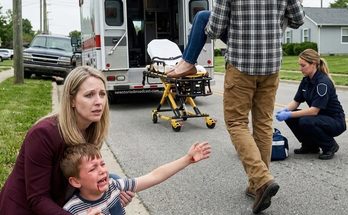
There are moments that don’t feel important when they happen, moments that arrive quietly, almost politely, and yet somehow manage to divide your life into something that existed before and something that can never return to it, and for me, that moment came on a night that smelled like rain and disappointment, standing in the doorway of the house I had always believed would be the one place I couldn’t be pushed out of. I was eighteen, still carrying that fragile certainty that family meant permanence, that no matter how much you argued or failed or fell short of expectations, there was always a line that wouldn’t be crossed, a point where someone would stop and say enough, you still belong here, but I learned very quickly that not all families are built on that kind of foundation, and that sometimes, belonging is conditional in ways you don’t understand until it’s taken from you without warning.
My father didn’t raise his voice that night, which somehow made it worse, because there was no anger to react to, no explosion that could be blamed on emotion or stress or something temporary. He spoke the way he always did when he had already made up his mind, calm, measured, as if the decision had been sitting with him long before I ever realized it existed, and when he told me to leave, it didn’t feel like an argument or even a punishment. It felt like a conclusion. I remember standing there, trying to understand what had just happened, replaying his words in my head as if I had misheard them, as if there was still time for them to mean something else, but the look on his face made it clear that there wasn’t. There was no hesitation, no doubt, no trace of the man who used to sit at the dinner table and ask about my day as if it mattered. There was only certainty. And in that certainty, there was no place left for me.
I didn’t pack much. There wasn’t time, or maybe there was and I just didn’t know how to use it. When you’re eighteen, you don’t think about what you’ll need in the long term. You think about the immediate, about getting through the next hour, the next night, the next place you’ll sleep. I took a bag, whatever was within reach, and stepped out into a world that felt suddenly unfamiliar, not because it had changed, but because my place in it had. The door closed behind me with a finality that didn’t echo, didn’t linger, didn’t offer the dramatic weight I thought it would carry. It just… ended. And I stood there for a moment longer than I should have, waiting for something that never came. No voice calling me back. No second thought. No sign that the line had been drawn too far.
Seventeen years is a long time to carry something like that, long enough for it to shape you in ways you don’t always recognize until you’re standing in a room full of people who remind you of exactly where it began. By the time I received the invitation to my brother’s wedding, I had built a life that existed entirely outside of that moment, a life that didn’t depend on approval or recognition from the people who had once defined me, and yet, holding that envelope in my hands, I felt something shift, something I hadn’t expected, a quiet pull back toward a place I had spent years learning how to live without. I almost didn’t go. There was no obligation strong enough to demand it, no relationship intact enough to justify it, but something in me—something I couldn’t quite explain—refused to let the story end without at least seeing how it had changed.
The venue was everything my father would have approved of, polished, expensive, carefully designed to impress in a way that left no room for imperfection, and as I walked in, I felt that same familiar distance settle over me, the sense of stepping into a world that looked complete from the outside but had no space carved out for me within it. People moved easily through the room, laughing, celebrating, existing in a shared understanding that I had once been part of and now stood just outside of, close enough to recognize but too far removed to belong. I saw my brother first, standing near the front, smiling in a way that looked practiced but genuine enough to pass, and for a moment, I wondered what he remembered of that night, what version of it had stayed with him over the years.
And then I saw my father.
Time had changed him, of course, softened some of the edges, added lines where there had once been certainty, but the way he carried himself hadn’t shifted, the same quiet authority, the same controlled presence, the same ability to command a room without raising his voice. When his eyes landed on me, there was a pause, brief but noticeable, the kind that suggests recognition without acknowledgment, and then it was gone, replaced by something more familiar, something I had seen too many times before to mistake for anything else.
Amusement.
He approached slowly, deliberately, as if the distance between us was something he could control simply by deciding how quickly to close it, and when he finally stood in front of me, there was no hesitation in his expression, no trace of the years that had passed, no indication that anything about our last interaction had left a mark.
“Well,” he said, his voice carrying just enough to draw attention from the people nearby, “look who decided to show up.”
The words were light, almost casual, but the tone beneath them carried something sharper, something designed to land in a very specific way, and I felt it immediately, the familiar pressure of being reduced to a version of myself that existed entirely within his narrative. People turned, curiosity flickering across their faces, the quiet shift of a room adjusting to a moment it hadn’t expected, and I realized then that this wasn’t just a greeting.
It was a performance.
Seventeen years had passed.
But in his mind—
I was still the one who didn’t belong.
PART 2 — The Version He Never Let Die
There is a particular cruelty in being reduced to a version of yourself that no longer exists, especially when it’s done in a room full of people who have no reason to question it, and as my father’s voice carried just enough to draw attention without seeming deliberate, I felt that familiar shift begin to take shape around me, the slow pull of a narrative I had spent years escaping quietly reasserting itself as if nothing in between had ever happened. It wasn’t loud at first, not in a way that demanded confrontation, but it didn’t need to be. It moved through the room in subtle waves—glances, half-smiles, the slight turning of bodies toward us as people recalibrated their attention, sensing something just outside the expected rhythm of celebration.
“I wasn’t sure you’d remember where we lived,” my father continued, the words delivered with that same controlled lightness that allowed him to pretend they were harmless, even as they landed with precision. There was a ripple of polite laughter from a small group nearby, the kind that doesn’t question context, only tone, and for a moment, I felt eighteen again, standing in that doorway with no space to explain, no room to exist outside of what he had already decided I was.
“I figured I’d find it,” I said, keeping my voice even, giving him nothing to push against, because I knew how this worked. I had seen it too many times. Any resistance would be turned into confirmation, any attempt to correct him reframed as defensiveness, and the story would continue exactly as he wanted it to.
“Still figuring things out?” he asked, louder now, just enough to extend the audience beyond those already listening, his tone carrying that same familiar amusement, as if my life were an ongoing joke he had been telling for years and this was just the latest installment. “Or did you finally land on something?”
The question wasn’t really a question. It was an invitation for the room to participate, to align themselves with the version of me he had curated, the one that was easier to understand, easier to dismiss. I could feel it in the way people leaned slightly closer, not overtly, not in a way that would seem intrusive, but enough to signal interest, enough to suggest that whatever came next would define how they saw me moving forward.
“I’m doing fine,” I replied, choosing simplicity over explanation, because anything more detailed would only serve to feed the performance, to give him material he could reshape into something that fit his narrative.
“Fine,” he repeated, the word stretching slightly in his mouth as if testing its weight, as if deciding how best to use it. “That’s… good.” He nodded once, slowly, the gesture carrying a hint of approval that felt more like condescension than anything genuine. “Everyone takes their own path, I suppose. Some just take a little longer to find it.”
More laughter.
Softer this time.
But sharper.
And for a moment, I let it sit, not because I didn’t feel it, but because I recognized something important in the way the room was responding. They weren’t laughing at me. Not exactly. They were responding to him, to his tone, to the authority he projected, to the assumption that he understood the situation better than anyone else in it. They were following the lead he had set, accepting it without question because there had been no reason to doubt it.
That was how it had always worked.
That was how he had made it real.
I glanced across the room then, not searching for support, but simply observing, taking in the space the way I had learned to do over the years, reading the dynamics without engaging in them, and that was when I noticed her.
The bride.
She stood near the edge of the crowd, partially turned toward us, her attention not divided the way everyone else’s was, not split between conversation and curiosity, but focused, deliberate in a way that felt out of place in a room built on casual interaction. She wasn’t smiling. She wasn’t reacting to the tone of the moment the way others were. She was watching.
Not him.
Me.
It wasn’t obvious at first, the kind of detail you might miss if you weren’t already looking for something different, but once I saw it, I couldn’t unsee it. There was recognition there, not the kind that comes from familiarity, but the kind that comes from knowing something others don’t, the kind that carries weight because it exists quietly, without needing to be announced.
For a brief second, our eyes met.
And in that moment, something shifted.
Not in the room.
But in the story.
Because for the first time since I had arrived, I felt something disrupt the pattern, something that didn’t belong to my father’s version of events, something that existed outside of his control.
He kept talking, of course.
He always did.
“…always had potential,” he was saying now, his voice still carrying that same easy confidence, the same subtle framing that allowed him to sound supportive while reinforcing the narrative beneath it. “Just never quite… committed.”
The words trailed slightly, not because he didn’t know how to finish the sentence, but because he didn’t need to. The implication was already there, already understood, already accepted by the room that had been following his lead from the beginning.
Except now—
someone wasn’t.
I saw it in the way the bride shifted her posture, the way she stepped slightly forward, not enough to interrupt, not yet, but enough to change her position in relation to the moment unfolding. Her expression didn’t harden, didn’t soften—it clarified, as if whatever she had been observing had just confirmed something she had already suspected.
And suddenly, for the first time that night, I wasn’t the only one holding something unspoken.
My father didn’t notice.
Not yet.
He was still focused on the performance, still moving through the lines he had used for years, unaware that the audience was no longer entirely his.
But I noticed.
And in that awareness, something inside me settled—not into comfort, not into confidence, but into readiness, the quiet understanding that whatever came next wasn’t going to follow the same path this moment had always taken before.
Because this time—
someone else knew the truth.
And they weren’t laughing.
PART 3 — The Voice No One Expected
There are moments when a room changes direction without anyone announcing it, when the energy that once moved in a single, predictable flow begins to hesitate, to fragment, to look for something new to follow, and as my father continued speaking with that same practiced ease, unaware that the rhythm had already begun to shift, I felt it happening—not in anything obvious, not in a sudden interruption or dramatic reaction, but in the quiet redirection of attention, the subtle reorientation of focus away from him and toward something else that had not yet fully revealed itself. It wasn’t loud. It didn’t need to be. It was enough that people were no longer fully listening, that their engagement had thinned just slightly, creating space for something new to enter.
And then, without warning, it did.
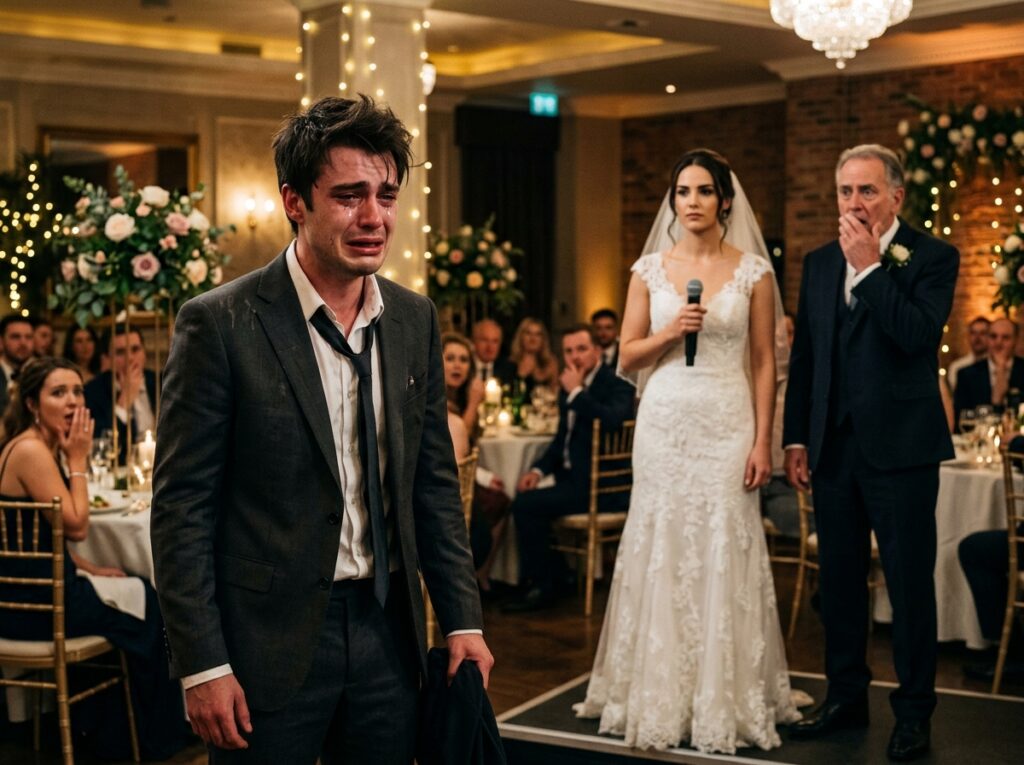
A soft but deliberate tap against the microphone echoed through the room, cutting cleanly through the conversation like a line drawn across the surface of something that had gone on just long enough. The sound wasn’t harsh, but it carried with it a kind of authority that demanded attention, not through force, but through certainty, and within seconds, the noise of the room began to settle, conversations trailing off as people turned instinctively toward the source.
The bride stood at the front now, one hand lightly resting on the stand, her posture composed in a way that felt natural but intentional, as if she had stepped into that position with a purpose that had nothing to do with timing or tradition. The moment could have been ordinary—just another speech, another part of the evening that followed the expected structure of celebration—but something about the way she held herself made it clear that this wasn’t going to follow the script everyone assumed it would.
“Before we continue,” she said, her voice calm, steady, carrying easily across the room without needing to rise, “I just want to take a moment.”
It sounded harmless.
Polite.
Exactly the kind of opening that allows people to relax, to settle into the expectation of something warm, something predictable. But as she spoke, her gaze moved—not across the room in a general sweep, not toward my brother standing nearby, but directly toward me—and in that single, deliberate shift, I felt the weight of the moment change completely.
My father noticed it too.
I saw it in the way his posture stiffened, in the slight narrowing of his eyes as he followed her line of sight, trying to understand what he was missing, what had slipped outside of his control without him realizing it. For the first time that night, he wasn’t leading the room. He was reacting to it.
“I know tonight is about family,” she continued, her tone unchanged, her delivery measured in a way that suggested she had already decided exactly how this would unfold, “about celebrating where we come from and the people who shaped us.”
There was a soft murmur of agreement, a few nods, the kind of collective response that comes from hearing something familiar, something expected. But she didn’t pause there.
She didn’t soften it.
“And I think,” she added, just slightly more deliberate now, “it’s also about acknowledging the parts of that story that don’t always get told.”
The room quieted again.
Not completely.
But enough.
Enough that the shift was undeniable, enough that people began to sense that this was no longer just a speech, no longer just part of the evening’s structure. It was something else. Something with direction.
My father shifted beside me, his presence no longer as steady as it had been, the confidence he carried beginning to fracture in small, barely visible ways. “What is this?” he muttered under his breath, not loud enough for anyone else to hear, but enough for me to catch the edge of uncertainty in his voice.
I didn’t answer.
I was watching her.
Because whatever this was—
it wasn’t accidental.
She stepped slightly away from the stand then, not losing control of the space but expanding it, creating movement where there had been stillness, her eyes still fixed in my direction as if the rest of the room existed only as context for what she was about to say next.
“Seventeen years is a long time,” she said, and the words landed differently than anything that had come before, not because of how they sounded, but because of what they carried, the weight of specificity in a moment that had previously been general, the sudden narrowing of focus that made it impossible to pretend this wasn’t intentional.
I felt it immediately.
So did he.
My father went completely still.
Because now—
this was no longer a performance he controlled.
“And sometimes,” she continued, her voice steady, unwavering, “people think they know the whole story of what happened back then.”
The room held its breath.
Not literally.
But close enough.
“They think they understand why someone left… or why they were made to leave.”
A ripple moved through the crowd then, not loud, not disruptive, but enough to signal recognition, enough to indicate that something important was being approached, something that had been sitting just beneath the surface of the evening without being named.
My father took a step forward.
Not fully.
Not enough to interrupt.
But enough to try.
“That’s not necessary,” he said, his voice carrying now, but lacking the ease it had held before, the authority weakened by the uncertainty that had begun to replace it. “This isn’t the time—”
“It is,” she said, cutting through him cleanly, not raising her voice, not changing her tone, but stopping him in a way that left no room for continuation.
The room went completely still.
Because now—
there was no question.
This was intentional.
This was directed.
This was happening.
She looked at me again, and this time there was no ambiguity in it, no distance, no subtlety.
Only clarity.
“Because the truth,” she said, “is that the person everyone thinks they understand…”
She paused.
Just long enough.
“…was never given the chance to be seen.”
And in that moment—
everything broke open.
Not fully.
Not yet.
But enough.
Enough that the story could no longer hold together the way it had before.
Enough that the version of me my father had spent seventeen years repeating—
was no longer the only one in the room.
PART 5 (Final Part) — The Truth He Couldn’t Control
There are moments when truth doesn’t arrive as a shock, but as something inevitable, something that has been moving quietly beneath everything else, waiting for the exact point where it can no longer be denied, and as the bride stood there with the room completely still around her, I understood that this was that moment, not because I didn’t know what she was about to say, but because I realized she had chosen to say it out loud, in a place where it could no longer be contained, no longer be rewritten, no longer belong to anyone but itself. The silence wasn’t uncomfortable anymore. It was focused, deliberate, the kind of silence that exists only when people know they are about to hear something that matters.
My father tried one last time.
“You don’t know what you’re talking about,” he said, but the words didn’t carry the weight they once had, didn’t command the room the way they always had before. There was strain in his voice now, something thin and uneven, as if the certainty he relied on had already started to collapse beneath him.
The bride didn’t look at him.
She didn’t need to.
“I know exactly what I’m talking about,” she said calmly, her gaze steady, her voice unwavering in a way that made it impossible to interrupt her again. “Because I was there… just not in the way everyone thinks.”
That was the first crack.
Not loud.
But undeniable.
A ripple moved through the room, subtle but immediate, the shift of people recalibrating their understanding, trying to place her within a story they didn’t fully know yet. My brother looked at her, confusion flickering across his face, the certainty of his own version of events suddenly unstable.
“What are you saying?” he asked, his voice quieter than it had been all night.
She took a breath, not out of hesitation, but out of control, the kind that comes from knowing exactly how much truth to release and when.
“I’m saying,” she continued, “that seventeen years ago, when he was kicked out…”
Her eyes moved to me, briefly, just long enough to acknowledge what we both already knew.
“…it wasn’t because he failed.”
The words landed like weight.
Not explosive.
But heavy enough to change everything they touched.
My father shook his head, faster now, the denial more visible, more urgent. “That’s not—”
“He found out,” she said, cutting through him again, not louder, not harsher, just more precise. “That you were using his name to cover your own mistakes.”
The room didn’t react all at once.
It stalled.
As if it needed time to understand what had just been said.
“What?” someone whispered.
And suddenly, the air shifted again.
Because this wasn’t about me anymore.
It was about him.
Seventeen years ago, I had been too young to fully understand what I had seen, too inexperienced to know what it meant, but I had known enough to question it, enough to confront him in a way that had forced something he wasn’t prepared to deal with. Contracts signed under my identity. Documents tied to decisions I hadn’t made. A version of events that placed me in positions I had never agreed to hold. I had thought it was a mistake at first. Something that could be explained. Something that would be corrected once it was brought into the open.
I had been wrong.
Because what followed wasn’t an explanation.
It was a decision.
His decision.
To remove the problem.
To remove me.
“He told everyone you were unstable,” the bride continued, her voice steady, controlled, each word placed exactly where it needed to land. “That you couldn’t handle responsibility. That you left on your own because you didn’t want to grow up.”
I could see it happening now.
The room connecting the pieces.
The timeline shifting.
The story changing shape in real time.
“And because you were eighteen,” she added, “and because he was respected, and because no one questioned him…”
She paused.
Just long enough.
“They believed him.”
The silence that followed wasn’t fragile anymore.
It was heavy.
Unavoidable.
My father didn’t speak.
He couldn’t.
Because there was nothing left to hold onto.
No version of the story he could reshape.
No audience that would follow him back into it.
He looked at me then, really looked at me for the first time in seventeen years, not as the version he had created, not as the person he had dismissed, but as something else entirely.
As the one who knew.
And had always known.
“Why didn’t you say anything?” he asked, but the question was empty now, stripped of authority, stripped of expectation.
I met his gaze without hesitation.
“I did,” I said quietly.
The words didn’t need anything else.
Because they carried everything.
The confrontation he had ignored.
The truth he had buried.
The choice he had made.
And in that moment, there was no anger left in me, no need to push further, no need to take anything from him that he hadn’t already lost. Because the power shift had already happened.
Not when I walked into the room.
Not when he mocked me.
Not even when she took the mic.
But now.
When the truth no longer belonged to him.
The bride stepped back then, the moment complete, the story no longer hers to carry, and for a brief second, the room didn’t move, didn’t react, as if everyone needed time to understand what had just unfolded in front of them.
My brother didn’t say anything.
The guests didn’t laugh.
And my father—
the man who had spent years controlling the narrative—
stood in silence.
Because for the first time—
he didn’t have one.
I turned to leave without saying anything more, not because I didn’t have something to say, but because I didn’t need to. The ending wasn’t in the words.
It was in the shift.
In the way the room had changed.
In the way he had changed.
And as I stepped out of that space, back into a life that no longer felt tied to what had happened inside it, I understood something that had taken me seventeen years to fully accept.
Being cast out didn’t mean I lost anything.
It meant I was removed from something that was never built on truth to begin with.
And sometimes—
that’s the only way you ever become free.
THE END