PART 1 — The Weight of Being Invisible
I learned very early that there are two kinds of silence in a family like mine—the kind that protects you, and the kind that erases you—and my father had always preferred the second, shaping it carefully, deliberately, until it became the only version of me that anyone else was allowed to see. Growing up in a house where respect was measured in ranks, achievements, and stories told loudly enough for others to admire, I never quite fit into the image he wanted to present to the world, and instead of adjusting the image, he adjusted me, trimming away the parts that didn’t align, softening the edges of who I was until I became something easier to explain, something quieter, something that didn’t disrupt the narrative he had built around himself. To his friends, especially the veterans he surrounded himself with like living trophies of a life he never quite let go of, I was introduced as “the kid who never stuck with anything,” the one who “tried a little of everything but never found direction,” and over time, those words stopped feeling like jokes and started feeling like definitions, the kind that follow you even when you don’t believe them anymore.
The gathering that night was supposed to be a celebration, another one of those evenings where old soldiers come together to remember things they don’t fully say out loud, filling the spaces between their stories with laughter that carries more weight than humor, but to me, it felt like a performance I had already seen too many times, one where I knew exactly what role I was expected to play. The house was full before I even arrived, voices overlapping in a steady rhythm of familiarity, the smell of bourbon and grilled meat hanging in the air, and the walls lined with photographs that told a version of history I had never been fully included in. Medals, unit patches, framed commendations—everything in that room spoke of identity, of belonging, of having earned a place that no one could question, and as I stepped inside, I felt the same quiet detachment I always did, like I was walking into someone else’s story rather than my own.
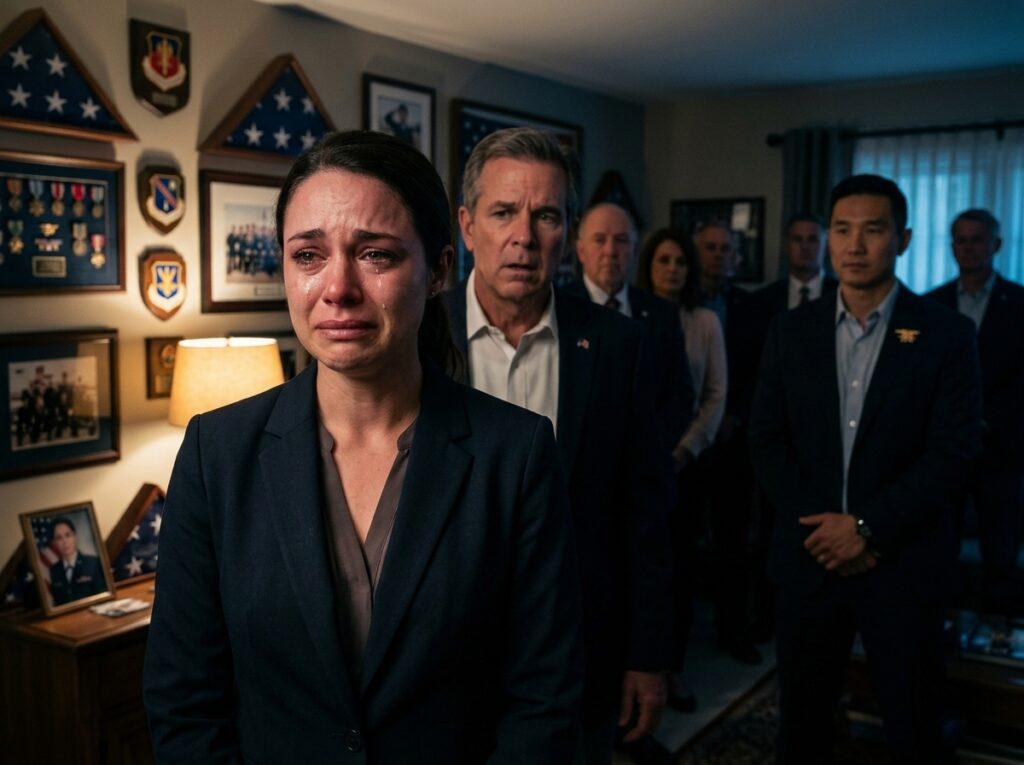
My father spotted me almost immediately, his posture straightening slightly in that subtle way that meant he was about to perform, his voice already carrying before I had even reached him. “Look who finally showed up,” he said, loud enough for the surrounding group to turn their attention in my direction, their expressions shifting from conversation to curiosity in an instant. “This is my kid,” he added, with that familiar half-smile that never quite reached his eyes, “still figuring things out.” The laughter that followed wasn’t cruel, not in the obvious sense, but it carried a tone I had learned to recognize—a polite amusement, the kind that allows people to participate without fully committing to the discomfort beneath it. I nodded, offering the same controlled smile I had practiced over the years, the one that acknowledged the joke without challenging it, the one that let the moment pass without giving it more weight than necessary.
I moved through the room the way I always did, greeting people who remembered me only as an extension of my father, listening to conversations that circled around experiences I wasn’t supposed to understand, and for a while, everything followed the same predictable pattern. Stories of deployments, of operations that were hinted at but never fully described, of losses that were softened by time but never erased—it was all familiar, all distant, all part of a world I existed near but never within, at least not in their eyes. And for a moment, I considered leaving early, slipping out quietly the way I had done before, avoiding the part of the night where the conversation inevitably turned back to me, to what I was doing, to what I wasn’t doing, to the version of my life that had been simplified into something easy to dismiss.
But then the door opened.
It wasn’t dramatic, not at first, just a subtle shift in the room as someone new entered, but the reaction it caused was immediate, the kind that doesn’t need to be explained because it’s built into the way people move, the way they stand, the way their attention redirects all at once. Conversations paused, shoulders straightened, and for a split second, the entire room felt different, heavier, more focused. I turned slightly, following the shift, and saw him standing there—tall, composed, carrying himself with the kind of quiet authority that doesn’t rely on introduction to be understood. He wasn’t in uniform, but he didn’t need to be. It was in the way he held himself, in the way his eyes moved across the room, assessing, recognizing, remembering.
“Jake,” my father said, his voice changing in a way I had rarely heard, something closer to respect than performance, and he stepped forward to greet him with a firm handshake that lingered just a second longer than usual. “Didn’t think you’d make it.”
“Wouldn’t miss it,” the man replied, his tone steady, controlled, the kind that suggests more than it reveals.
They spoke briefly, exchanging words that carried layers I didn’t fully catch, references to places, to people, to moments that existed outside the surface of the conversation, and I watched from a distance, recognizing the shift in my father’s posture, the way he stood a little straighter, spoke a little more carefully, as if he were aware of being evaluated in a way that mattered. Then, almost as an afterthought, he gestured in my direction.
“This is my kid,” he said again, the same introduction, the same tone, the same dismissal wrapped in casual humor. “Still trying to figure out what they want to be.”
The man—Jake—turned toward me then, his gaze landing on me with a focus that felt different from the others, not dismissive, not curious in the usual way, but something sharper, something more deliberate. For a moment, he didn’t say anything, and in that silence, I felt something shift, something subtle but undeniable, like the air had changed in a way only I could notice.
And then, slowly, his expression changed.
Not into recognition exactly.
But into something very close to it.
And in that moment, for the first time that night, I realized something wasn’t going to follow the usual pattern.
PART 2 — Recognition Is a Dangerous Thing
There is a particular kind of silence that settles over a room when something shifts beneath the surface, the kind that doesn’t stop conversation completely but alters it just enough that you can feel the difference if you’re paying attention, and as Jake’s gaze lingered on me a second longer than necessary, I felt that shift in a way I hadn’t experienced in years, like something I had carefully kept contained was beginning to move on its own, no longer entirely under my control. It wasn’t obvious to anyone else—not to the veterans who returned to their stories after a brief pause, not to my father who had already turned slightly away as if the introduction had served its purpose—but it was unmistakable to me, because I recognized that look, even if I hadn’t seen it directed at me in a long time. It wasn’t curiosity. It wasn’t confusion. It was assessment, quiet and precise, the kind that doesn’t ask questions out loud because it’s already gathering answers in ways that don’t require permission.
Jake didn’t speak immediately, and in that space between acknowledgment and response, I felt something tighten in my chest, not fear exactly, but awareness, the kind that sharpens your thoughts without speeding them up, that forces you to consider not just what is happening, but what might follow. When he finally extended his hand, his movement was measured, deliberate, and when our hands met, the grip was firm without being aggressive, steady in a way that communicated more than any introduction could. “Good to meet you,” he said, his voice even, controlled, but there was something underneath it, something that didn’t align with the casual nature of the words. I nodded, matching his tone as closely as I could, offering nothing more than what was expected, because I understood instinctively that anything more would draw attention in a way I couldn’t afford.
For a moment, it seemed like the interaction might end there, that whatever he thought he recognized would remain unspoken, folded neatly back into whatever space it had come from, but then he did something unexpected. Instead of turning away, instead of rejoining the conversation that had already resumed around us, he shifted slightly, just enough to block my father’s line of sight without making it obvious, and lowered his voice in a way that ensured only I could hear him.
“Where were you stationed?” he asked.
It was a simple question on the surface, the kind that could easily pass as polite interest in a room like this, but the weight behind it was anything but casual, and for a fraction of a second, I considered giving the same answer I always did—the one that deflected without lying, that ended the conversation before it could begin—but something in the way he held my gaze told me that wouldn’t work this time. He wasn’t asking to make conversation. He was asking to confirm something.
“I moved around,” I said instead, keeping my tone neutral, offering just enough to acknowledge the question without providing anything that could be easily traced.
His expression didn’t change, but I saw it—the smallest shift, the almost imperceptible narrowing of his eyes, the way his attention sharpened rather than relaxed, as if my answer had done exactly what he expected it to do. “Yeah,” he said quietly, almost to himself, “I figured.”
That should have been the end of it. It would have been, with anyone else. But Jake wasn’t like the others in the room, wasn’t content with surface-level explanations or polite boundaries, and instead of stepping back, he leaned in just slightly, his voice dropping even lower.
“They don’t know, do they?” he asked.
The question hit harder than I expected, not because it was surprising, but because of how directly it cut through everything I had built to keep moments like this from happening. I didn’t answer right away, not because I needed time to think, but because I needed to decide whether this was something I could still contain. Around us, the room continued as if nothing had changed, laughter rising and falling, glasses clinking, stories unfolding in familiar patterns, but for me, everything had narrowed to this single point, this quiet exchange that carried more risk than anything that had happened all night.
“No,” I said finally, my voice steady, controlled, leaving no room for interpretation.
He studied me for a moment, not challenging the answer, not pushing further, but not dismissing it either, and then, slowly, he nodded, as if confirming something that had already been decided before I spoke. “Thought so,” he murmured, and this time, there was something else in his tone—respect, maybe, or recognition, something that didn’t belong to the version of me my father had presented to the room.
For a brief moment, I allowed myself to believe that might be enough, that he would let it rest there, that whatever connection he had made would remain contained within that exchange, but then my father’s voice cut through the space between us, louder than necessary, pulling attention back in a way that felt almost deliberate.
“Hey, Jake,” he called out, gesturing toward us with a casual confidence that didn’t match the tension I could feel building beneath the surface, “you talking to my kid about career advice? Might be the most direction they’ve had in years.”
The laughter that followed was immediate, predictable, the same pattern repeating itself in a way that should have felt familiar, but this time, it didn’t land the same. This time, something about it felt off, like the rhythm had shifted just enough to break the illusion. Jake didn’t laugh. He didn’t even smile. Instead, he straightened slightly, his posture changing in a way that was subtle but unmistakable, and when he turned to face my father, the air in the room seemed to adjust around him.
“Yeah,” he said, his voice carrying just enough to be heard by more than just the two of us now, “we were talking.”
There was a pause, brief but noticeable, the kind that doesn’t interrupt a room completely but draws just enough attention to create a space where something else could happen, and in that pause, I felt it—the edge of something that couldn’t be pulled back once it started.
Jake looked at me again, just for a second, and in that glance, there was a question, unspoken but clear.
Do you want me to say it?
And for the first time that night, I hesitated.
Not because I was afraid of the truth.
But because I understood exactly what it would cost once it was out.
PART 3 — The Name They Weren’t Meant to Hear
There are moments in life when everything changes all at once, not because of something loud or explosive, but because of something quiet that cannot be undone once it exists, and as I stood there under the weight of Jake’s unspoken question, I understood with absolute clarity that whatever happened next would not stay contained within the boundaries I had spent years maintaining. It would move outward, into the room, into the version of my life my father had so carefully constructed, and once it did, there would be no returning to the silence that had protected me for so long. The decision wasn’t about whether the truth was real—it always had been—but whether I was willing to let it exist where it had never been allowed before.
I didn’t answer him.
Not with words.
But sometimes, silence is enough.
Jake saw it. I knew he did, not because he reacted immediately, but because of the way his posture settled into something firmer, something resolved, as if a line had been drawn and he had already chosen which side he stood on. When he turned back toward my father, the room didn’t quiet all at once, but it began to shift, conversations faltering just slightly as people sensed that something different was happening, something that didn’t belong to the usual rhythm of shared stories and easy laughter.
“Sir,” Jake said, and the word alone was enough to change the atmosphere, because it wasn’t casual, wasn’t friendly—it carried structure, hierarchy, recognition—and my father straightened instinctively, responding to it without even realizing why. “With respect,” he continued, his voice controlled but no longer quiet, “I don’t think you understand who you’re talking about.”
The laughter that had lingered in the room died slowly, unevenly, as if people weren’t sure whether to treat the moment as a joke or something else entirely. My father frowned slightly, his expression caught somewhere between confusion and irritation, the first signs of discomfort surfacing in a way I had never seen before. “I think I know my own kid,” he said, forcing a chuckle that didn’t quite land, looking around as if expecting agreement, expecting the room to support the version of reality he had always presented.
Jake didn’t look at anyone else.
He looked at me once more.
Then back at my father.
“No, sir,” he said, steady, unwavering, “you don’t.”
That was the moment the room went quiet.
Not completely silent, not in a dramatic, cinematic way, but in the subtle, unmistakable way that happens when something important is about to be said, when people stop talking not because they’re told to, but because something in the air demands their attention. I could feel it in the shift of bodies, in the way eyes began to turn, in the way the space that had once felt crowded now felt focused, directed, as if everything was narrowing toward a single point.
Jake took a breath, not as hesitation, but as control.
“I served under them,” he said.
The words landed differently than anything that had come before, not because they were loud, but because of the weight they carried, the authority embedded within them, the way they reframed everything without needing explanation. My father’s expression changed immediately, the confusion sharpening into something more focused, more uncertain, as if he were trying to process a statement that didn’t fit into any version of reality he recognized.
“What?” he asked, the word short, abrupt, stripped of the confidence he usually carried.
Jake didn’t rush.
“They were attached to our unit during classified operations,” he continued, his tone measured, each word placed carefully, deliberately, “and in the field…” He paused, just long enough to let the weight of what he was about to say settle into the silence that had formed around us. “We had a name for them.”
I felt it then—the shift.
Not just in the room.
But in him.
Because this wasn’t about recognition anymore.
This was acknowledgment.
“The Angel of Death,” he said.
There are phrases that echo after they’re spoken, not because they’re loud, but because of what they carry with them, and as those words settled into the space around us, everything seemed to stop—not completely, not physically, but in a way that made every movement feel slower, heavier, as if the room itself needed time to adjust to what it had just heard.
No one laughed.
No one spoke.
Because no one knew how.
My father stared at him, the expression on his face shifting through disbelief, confusion, something that looked almost like denial, as if rejecting the words might somehow undo them. “That’s not funny,” he said, but there was no humor in his voice, no certainty, just a thin edge of something unfamiliar.
Jake didn’t react.
“It’s not a joke, sir,” he replied, calm, direct.
And then, for the first time, all night—
they looked at me.
Not the way they had before.
Not as an afterthought.
Not as an extension of someone else.
But as something they didn’t understand.
Something they hadn’t been told.
Something that didn’t fit into the version of me they had accepted without question.
I didn’t move.
I didn’t speak.
Because there was nothing left to say.
The truth didn’t need me to explain it.
It was already there.
And in that moment, the weight I had carried for years—the silence, the dismissal, the constant reduction of who I was—shifted, not disappearing, but changing form, becoming something that no longer belonged only to me.
My father opened his mouth, closed it again, the words he had relied on for so long suddenly out of reach, his certainty fractured in a way that couldn’t be hidden. For the first time in my life, he didn’t know what to say.
And for the first time—
he was the one who felt small.
PART 4 — The Cost of Being Erased
Silence, once it settles fully, has a way of exposing everything that noise was hiding, and as the weight of Jake’s words continued to press down on the room, I could feel the shift extending beyond that single moment of revelation, moving through each person present in a way that forced them to re-evaluate not just what they had heard, but what they thought they knew. The laughter that had once filled the space was gone now, replaced by something far more fragile, something uncertain, as if the foundation of the evening had cracked and no one was entirely sure how to stand on it anymore. For me, the quiet wasn’t new. I had lived inside it for years. But this time, it belonged to everyone.
My father tried to recover first.
He always did.
I saw it in the way his shoulders squared slightly, in the way he cleared his throat, as if resetting himself into the version of authority he had relied on his entire life, the one that had carried him through rooms like this without question. “You’ve got the wrong person,” he said, forcing a steadiness into his voice that didn’t quite hold, the edges of it too sharp, too controlled, as if it required effort to maintain. “My kid doesn’t—” He stopped mid-sentence, the words catching somewhere between what he believed and what he was beginning to suspect.
Jake didn’t interrupt.
He didn’t need to.
“Sir,” he said again, and this time there was no softness in it, no attempt to ease the impact, “I don’t make that kind of mistake.”
The statement landed cleanly, without aggression, without hesitation, and in that clarity, something inside my father faltered in a way I had never witnessed before. He wasn’t just being contradicted. He was being corrected. And not privately, not in a space where he could regain control quietly, but here—surrounded by the very people he had spent years performing for, the very audience that had shaped his identity into something solid, something unquestioned.
And now that foundation was shifting.
“Then explain it,” my father said, but the demand lacked its usual force, the authority behind it weakened by uncertainty. “Explain how that makes any sense.”
Jake glanced at me briefly, not for permission, but for acknowledgment, and then he turned back to the room, his posture settling into something that carried weight beyond explanation.
“There are operations,” he said slowly, carefully, “that don’t exist on paper. Units that aren’t named. Personnel that aren’t acknowledged outside of very specific channels.” His eyes moved across the room as he spoke, not searching for approval, but ensuring understanding. “You don’t hear about them. You don’t read about them. And if you’re not part of it…” He paused. “You assume they’re not real.”
The room absorbed that in silence.
“But they are,” he added.
My father shook his head slightly, the movement small but firm, clinging to resistance in the only way he knew how. “You’re saying my kid was part of something like that?” he asked, but it wasn’t really a question anymore. It was disbelief trying to hold its ground.
“I’m saying,” Jake replied, his voice steady, “that your kid was the one we called when things went wrong.”
The shift in the room was immediate.
Not dramatic.
But undeniable.
Because now it wasn’t just a title. It wasn’t just a name that sounded like something pulled from a story. It was context. It was function. It was meaning.
And with meaning came weight.
I could feel it in the way people looked at me now, not just with confusion, but with something closer to recognition, as if they were trying to reconcile the person they thought they knew with the one that was now being described in front of them. It wasn’t admiration. Not yet. It was something more complex, more cautious, the kind of attention that comes when people realize they have misjudged something important.
My father saw it too.
And that was what broke him.
Not completely. Not outwardly. But in the way his confidence fractured just enough to become visible, in the way his voice, when he spoke again, carried something unfamiliar.
“Why wouldn’t I know?” he asked, and this time, the question wasn’t directed at Jake.
It was directed at me.
For the first time that night, he was looking at me—not as an extension of himself, not as a disappointment to be explained, but as something separate, something unknown, something that had existed outside of his control without him realizing it.
And that, more than anything else, was what unsettled him.
I met his gaze without hesitation, not with defiance, not with anger, but with a kind of calm that came from having already lived through everything he was only beginning to process.
“Because you never asked,” I said.
The words were simple.
But they carried years.
Years of dismissal. Years of assumption. Years of being reduced to something smaller because it was easier than understanding something more complicated.
He blinked, as if the answer didn’t fit, as if it didn’t align with the narrative he had built, and for a moment, I saw something I had never seen before in him.
Not anger.
Not authority.
But uncertainty.
“You think I wouldn’t have listened?” he asked, but there was no certainty behind it now, no conviction, just a question that had come too late.
I didn’t raise my voice.
I didn’t need to.
“I think,” I said, evenly, “you already decided who I was.”
The room held that in silence.
Because that was the truth beneath everything else.
Not the operations.
Not the rank.
Not the name Jake had given me.
But that.
The decision that had been made long before any of this, the quiet, consistent choice to see me a certain way and never question it.
Jake didn’t speak again.
He didn’t need to.
The moment had shifted beyond explanation.
My father looked around the room then, as if searching for something—support, agreement, anything that might stabilize what he was losing—but the expressions he found didn’t offer it. They were careful now, measured, no longer aligned with him in the easy way they had been before.
Because the story had changed.
And he wasn’t the one telling it anymore.
PART 5 (Final Part) — The Moment He Finally Saw Me
There is a point in every story where everything that has been building, quietly and relentlessly, reaches a place where it can no longer remain unresolved, where the weight of everything unsaid demands to be acknowledged, and as I stood there in that room, surrounded by the silence that had once belonged only to me but now belonged to everyone, I understood that this was that moment, not because anything more needed to be revealed, but because for the first time, nothing was being hidden. The truth had already been spoken. The roles had already shifted. And what remained was something far more difficult than exposure. It was understanding.
My father didn’t speak right away.
He stood there, looking at me in a way that felt unfamiliar, as if he were trying to find the version of me he had always known and couldn’t quite locate it anymore, as if the person standing in front of him had replaced something he thought was fixed, something he had defined so completely that he had never imagined it could be wrong. There was no anger in his expression now, no defensiveness, no attempt to regain control of the narrative. There was only something quieter, something that looked dangerously close to realization.
“I didn’t know,” he said finally, but even as the words left him, it was clear they weren’t enough, not as an explanation, not as an apology, not as anything that could bridge the distance that had existed between us for years.
“I know,” I replied.
And I meant it.
Because this had never been about a single moment of ignorance. It had been about a pattern. A choice. A consistent, quiet refusal to look beyond what was easy to understand. And standing there, watching him struggle with the weight of that realization, I didn’t feel the anger I once thought I would. I didn’t feel the need to prove anything further. Because the proof wasn’t the point anymore.
Recognition was.
Around us, the room remained still, the veterans who had once laughed now silent, their attention fixed not on the story being told, but on the shift that had taken place in front of them. And in that silence, something else began to emerge—not loud, not overwhelming, but steady. Respect. Not the kind that comes from rank alone, not the kind that is given automatically, but the kind that grows from understanding, from seeing something clearly after having misunderstood it completely.
Jake was the first to break that silence.
He stepped back slightly, not to remove himself from the moment, but to give it space, to allow what had already been said to settle without adding anything unnecessary. He didn’t look at me again. He didn’t need to. The acknowledgment had already been given.
And that was enough.
My father shifted his weight, his gaze still fixed on me, but softer now, less certain, as if he were recalibrating everything he thought he knew, not just about me, but about himself. “Why didn’t you tell me?” he asked, and this time, the question wasn’t defensive. It was searching.
I could have answered him in a hundred different ways.
I could have listed the moments where he didn’t listen, the times where he dismissed me before I had the chance to speak, the years where silence had been easier than fighting for space that was never going to be given freely. I could have made him feel the weight of every missed opportunity, every assumption, every time he chose the easier version of me over the real one.
But I didn’t.
Because none of that would change what had already happened.
“You never needed to know,” I said instead, my voice steady, not cold, not distant, but clear in a way that left no room for interpretation.
He flinched slightly, not from the words themselves, but from what they carried.
Not rejection.
But independence.
And in that moment, something shifted again—not in the room, not in the way people looked at me, but in the space between us, the place where expectation had once lived and where, now, something else had taken its place.
Distance.
Not the kind that separates people physically, but the kind that forms when understanding arrives too late to rebuild what was never properly constructed in the first place.
“I would have been proud,” he said quietly, almost as if the words were meant for himself more than for me.
I held his gaze, not challenging him, not softening the truth, simply meeting it as it was.
“I didn’t need you to be,” I replied.
The room absorbed that in silence.
Because that was the real ending.
Not the reveal.
Not the title.
Not the shift in power.
But that.
The moment where validation no longer mattered.
The moment where everything I had spent years carrying—every doubt, every dismissal, every quiet attempt to be seen—simply… stopped.
Not because it was fixed.
But because it was no longer mine to carry.
I stepped back then, not dramatically, not with finality, but with intention, creating space where there had once been expectation, and for the first time in that house, in that room, in that version of my life, I felt something I hadn’t allowed myself to feel before.
Lightness.
Not relief.
Not victory.
But clarity.
Because the truth doesn’t always change the past.
But it does change who holds power over it.
And as I turned to leave, the room parting just slightly in a way that hadn’t happened before, I understood something that had taken me years to fully accept.
I had never been invisible.
I had only been unseen.
And now—
that was no longer my problem.
THE END