PART 1 — The Name They Took From Me
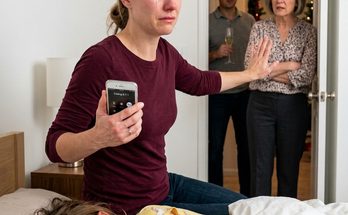
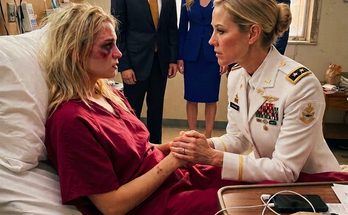
There are names you are given at birth, names that carry expectation before you are old enough to understand what they mean, and then there are the names that are slowly taken from you, replaced piece by piece until what remains no longer feels like something you chose, but something that was decided for you long before you had the chance to become anything else, and for most of my life, the name my family used when they spoke about me wasn’t spoken directly, wasn’t written down, wasn’t acknowledged in any formal way, but it existed all the same, built into the way they looked at me, the way they spoke around me, the way every conversation about my future carried a quiet assumption that I had already failed before I had even begun.
It didn’t happen all at once. It never does. It started small, almost invisible, with comments that sounded like concern but carried something sharper underneath, questions that weren’t really questions but confirmations of what they already believed, and over time, those moments added up, layering themselves into something that became harder and harder to push against. When I left school early, not because I couldn’t continue but because I chose a different path they didn’t understand, that was the first time the word “dropout” entered the conversation, said lightly at first, almost jokingly, as if it didn’t mean anything serious. But words have a way of settling into spaces if they’re repeated often enough, and before long, it stopped being a description of a decision and became a definition of who I was.
At family gatherings, it was always there, lingering just beneath the surface, waiting for the right moment to emerge. “Still figuring things out?” someone would ask, their tone polite but their expression already carrying the answer they expected. “You’ll find your place eventually,” another would add, as if the timeline had already been exceeded, as if I was behind on something no one had ever clearly defined. My parents didn’t defend me. Not directly. They didn’t need to. They had already accepted the version of me that made the most sense to them, the one that fit neatly into a story where success looked a certain way and anything outside of that was temporary at best, permanent at worst.
And then there was my brother.
He didn’t say much. He didn’t have to. He was everything they understood—structured, disciplined, predictable in a way that made people comfortable. When he spoke about his career, about his training, about the future he was building step by step, the room listened. When I spoke, if I spoke at all, it felt like an interruption, something that needed to be acknowledged but not necessarily absorbed. Over time, I learned to say less, to exist within the margins of conversations that were never meant to include me fully, to let the version of me they had created stand without correction because correcting it required more energy than I was willing to give.
The last time I sat at that table before everything changed, I remember the way the conversation shifted toward me without warning, the way it always did, like a spotlight that wasn’t meant to illuminate but to expose. “So what are you doing now?” my father asked, his voice calm, measured, the same tone he used when he already knew the answer and didn’t expect it to change. I could have told him. I could have explained the path I had chosen, the work I was doing, the reason behind every decision that had led me there, but I saw it in his expression before I even spoke—the lack of interest, the quiet dismissal already in place—and I understood that it wouldn’t matter.
“Working,” I said simply.
He nodded, as if that confirmed everything. “Right,” he replied, the word carrying just enough weight to end the conversation without continuing it. And just like that, I was dismissed again, not loudly, not dramatically, but completely.
That was the moment I stopped trying.
Not in the way they thought. Not in the way that confirmed their version of me. But in the way that mattered.
I stopped trying to be understood by people who had already decided I wasn’t worth understanding.
Years passed.
Not slowly, not quickly, just steadily, each one adding distance between the life I had left behind and the one I was building without them. I didn’t cut contact entirely. That would have been too noticeable, too final. Instead, I became something else—distant, infrequent, present only when necessary, existing just enough to maintain the illusion of connection without allowing it to define me anymore. They continued to believe what they wanted. I continued to let them.
Until the day they decided to visit.
It wasn’t planned. Not by me. My mother had mentioned something about wanting to see where I worked, about finally understanding what I had been doing all this time, and before I had the chance to redirect the conversation, to suggest something else, something easier, the decision had already been made. They were coming.
The base wasn’t the kind of place you stumbled into. It wasn’t open, wasn’t casual, wasn’t designed for comfort or familiarity. It was structured, controlled, built on layers of authority that didn’t need to announce themselves to be understood, and as I stood at the entrance waiting for them, I felt something I hadn’t felt in a long time.
Not anxiety.
Not doubt.
But anticipation.
Because for the first time, the two versions of my life were about to collide in a way that couldn’t be managed, couldn’t be softened, couldn’t be explained away.
Their car pulled up slowly, hesitation visible even in the way it stopped, as if the environment itself had already begun to challenge their expectations. My father stepped out first, his posture instinctively adjusting as he took in the surroundings, the familiarity of discipline triggering something in him he hadn’t realized he still carried. My mother followed, her expression softer, more curious, but still uncertain.
They saw me.
And for a moment, nothing changed.
I was still the same person they had always known.
Still the one who hadn’t fit.
Still the one they had already defined.
“Didn’t expect this,” my father said, looking around, his tone neutral but edged with something he couldn’t quite place.
“It’s just where I work,” I replied.
He nodded slowly, not fully convinced, not fully dismissive, somewhere in between.
And then—
it happened.
A voice cut across the yard, sharp, clear, carrying authority in a way that demanded immediate attention.
“Stand to!”
Everything stopped.
Movement shifted.
Postures changed.
And before my family could fully process what was happening—
a sergeant turned toward me.
Stepped forward.
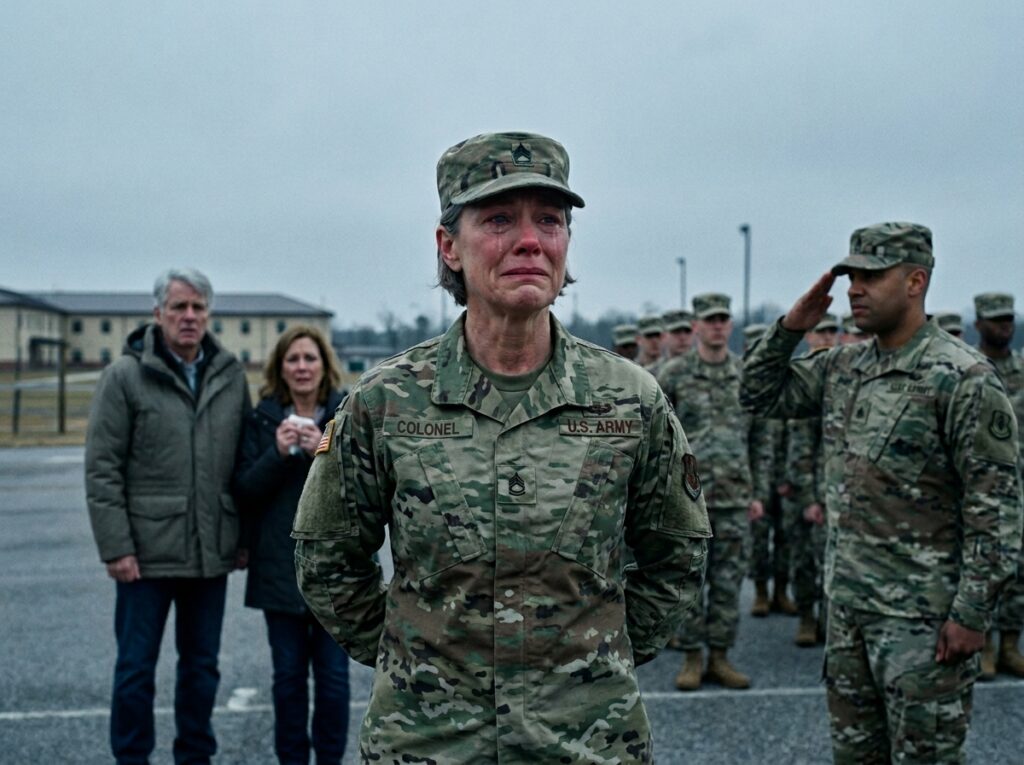
And snapped into a salute so precise, so immediate, so absolute—
that the entire drill yard seemed to freeze around it.
“Commander Hale,” he said.
And for the first time in my life—
my name belonged to me again.
PART 2 — The Rank They Couldn’t Deny
There are moments when reality doesn’t arrive gently, when it doesn’t ease itself into understanding but instead forces its way in all at once, leaving no room for interpretation, no space for denial to take hold, and as the sergeant’s salute cut cleanly through the air with a precision that could not be mistaken for anything casual, I watched the impact of that moment land on my family in a way that felt almost surreal, not because I didn’t expect it, but because I had spent so many years imagining what it might look like that seeing it unfold in real time carried a weight I hadn’t fully prepared for. The yard itself seemed to hold its breath, the surrounding movement adjusting instantly to the structure of command, personnel shifting positions with quiet efficiency, each action reinforcing something my family had never had the chance—or the willingness—to understand.
My father didn’t react immediately.
That was the first sign.
He stood there, frozen just long enough for the moment to extend beyond what could be explained away as coincidence, his expression caught between confusion and resistance, as if his mind was searching for an interpretation that would allow him to maintain the version of reality he had carried for years. My mother’s gaze moved from the sergeant to me and back again, her uncertainty more visible, less controlled, the beginnings of recognition forming in a way she didn’t yet know how to process.
“That’s not…” my father started, but the words didn’t complete themselves, trailing off as if even he wasn’t sure what he was trying to deny.
The sergeant lowered his salute only after I acknowledged it with a small, almost imperceptible nod, the motion so subtle that it might have been missed by anyone unfamiliar with the exchange, but to those around us, it was enough. The structure of the moment had been confirmed. The line had been drawn.
“At ease,” I said, my voice calm, steady, carrying the kind of authority that doesn’t need to be raised to be heard, and as the command settled into the space around us, the yard responded in kind, the tension easing without disappearing, the awareness of hierarchy remaining present even in stillness.
My father looked at me then, really looked, but not in the way he had before, not through the lens of assumption or dismissal, but with something closer to confusion, as if he were trying to reconcile two versions of me that could not logically exist at the same time. “What is this?” he asked, his voice lower now, less certain, the confidence he had always relied on beginning to fracture at the edges.
“This is my command,” I replied.
The simplicity of the answer seemed to unsettle him more than anything else.
Because there was no explanation in it.
No justification.
No attempt to make it easier to understand.
It simply… was.
“That’s not possible,” he said, the words coming faster now, more urgent, as if saying them quickly enough might make them true. “You—you left school. You never—” He stopped again, the gaps in his understanding widening in ways he couldn’t immediately fill.
“I chose a different path,” I said, meeting his gaze without challenge, without apology.
He shook his head slightly, the movement small but firm, clinging to resistance in the only way he could. “You don’t just become—” he gestured vaguely toward the sergeant, toward the structure around us, toward everything that now contradicted what he believed, “this. Not without—”
“Without what?” I asked.
The question wasn’t aggressive.
It didn’t need to be.
Because the answer he was searching for didn’t exist in the way he needed it to.
Training.
Discipline.
Commitment.
Everything he had assumed I lacked—
was standing in front of him.
A second officer approached then, his pace controlled, his posture precise, and the moment he reached us, he didn’t hesitate. He didn’t look at my father. He didn’t acknowledge my mother. His attention was entirely on me.
“Commander,” he said, his tone formal, respectful, “we’re ready for your briefing.”
There was no hesitation in his voice.
No uncertainty.
Only recognition.
And with that single word, spoken so naturally, so easily, something shifted again—not just in my father, but in the space around us, the reality of the situation solidifying in a way that could no longer be dismissed as misunderstanding.
“I’ll be there in a minute,” I replied.
“Yes, sir,” he said, and stepped back without another word.
Silence followed.
Not the kind that feels empty.
But the kind that feels full of things that have not yet been processed.
My mother was the first to move, her eyes still fixed on me, searching, not for contradiction, but for confirmation, for something that would allow her to understand what she was seeing without having to reject everything she had believed before. “Why didn’t you tell us?” she asked, her voice soft, uncertain, the question carrying more weight than accusation.
I could have answered her in a hundred different ways.
I could have explained the years of training, the decisions, the moments that had shaped me into who I had become. I could have told her about the sacrifices, the nights that blurred into mornings, the weight of responsibility that came with every step forward.
But none of that was the real answer.
“You already decided who I was,” I said.
The words landed quietly.
But they didn’t need to be loud.
Because they carried truth.
My father didn’t respond right away, his gaze shifting away from me for the first time, moving across the yard as if searching for something that could ground him, something that could restore the certainty he had always relied on. But there was nothing there that fit the version of reality he had brought with him.
Only structure.
Only order.
Only proof.
And all of it—
pointed to me.
PART 3 — The Weight of What I Became
There is a difference between knowing something exists and understanding what it means, and as the silence stretched between us on that drill yard, I could see that my family had crossed the first threshold but not the second, standing in a space where the reality in front of them could no longer be denied, but the meaning behind it still felt distant, incomplete, as if they were looking at something solid without fully grasping the weight it carried. The structure around us had already confirmed my position, the salutes, the tone, the absence of hesitation from those who operated within this world, but structure alone does not create understanding. It only removes doubt. And what remained, what began to settle into the space left behind, was something far more difficult to process.
My father was the first to speak again, but this time, there was no performance in his voice, no attempt to control the narrative, only a need—urgent and unfamiliar—to make sense of what he was seeing. “Commander,” he repeated, as if testing the word, as if saying it out loud might help him reconcile it with the version of me he had carried for years. “You’re telling me… this is real?”
“I’m not telling you anything,” I said evenly. “You’re seeing it.”
That was the part he couldn’t escape.
Because this wasn’t something I had chosen to reveal.
It was something he had walked into.
A third figure approached then, slower than the others, his movement deliberate in a way that carried more weight than urgency, and when he stopped a few feet away, there was a subtle shift in the way the space around him responded, not outwardly, not in a way that would draw immediate attention from someone unfamiliar, but enough that those within this structure recognized it instinctively. He wasn’t just another officer. He didn’t need to announce it.
“Commander Hale,” he said, his voice low but firm, carrying a level of familiarity that didn’t exist in the others. “We’ve received confirmation from the eastern sector. They’re requesting your authorization before proceeding.”
There was no hesitation in his tone.
No question of whether I would respond.
Only the assumption that I would.
I held his gaze for a moment, processing the information, the details falling into place in a way that felt automatic, the years of training, of decision-making under pressure, shaping my response without requiring conscious effort.
“Hold them at current position,” I said. “No movement until I review the intel personally.”
“Yes, sir,” he replied, a slight nod marking the end of the exchange before he turned and moved away, the conversation complete, the authority behind it unquestioned.
When I looked back at my family, the difference was immediate.
Not just in what they had seen.
But in what they had understood.
Because this wasn’t just rank anymore.
This wasn’t just structure.
This was responsibility.
Real.
Immediate.
Unavoidable.
My mother’s expression had changed first, the uncertainty giving way to something deeper, something that looked almost like recognition, not of the details, but of the weight, the realization that whatever path I had taken had not been easy, had not been accidental, had required something she had never been given the chance to see.
My father, however—
was unraveling.
Not outwardly.
Not in a way that would be obvious to anyone else.
But I knew him well enough to see it.
The way his posture no longer held the same certainty.
The way his eyes moved, searching for something to anchor himself to and finding nothing that aligned with what he had believed.
“You said you were just working,” he said finally, the words quieter now, stripped of the authority they once carried.
“I was,” I replied.
“That’s not…” He stopped, the sentence breaking apart before it could fully form, because there was no version of it that could make sense of what stood in front of him.
“It wasn’t something I could explain,” I added.
That was the closest I came to offering anything beyond the present.
Because the truth was more complicated than anything he could accept in that moment.
The reason I had left school.
The reason I had chosen a path that didn’t make sense to them.
The reason I had allowed them to believe what they wanted.
None of it fit into a simple explanation.
None of it could be reduced to something that would make them comfortable.
And comfort had never been part of this.
“They call you ‘Commander’ like it’s…” He hesitated, searching for the word.
“Normal?” I offered.
He nodded slowly.
“Because it is,” I said.
That was the part he struggled with the most.
Not that I had achieved something.
But that I had done it without them.
Without their understanding.
Without their approval.
Without their narrative.
Another group of soldiers moved across the yard in the distance, their formation precise, their movements synchronized in a way that spoke of discipline built over time, and as my father watched them, I could see the realization taking shape, the slow, unavoidable recognition that whatever I had become existed within a world he understood—but not in the way he had expected.
“You don’t just get here,” he said, almost to himself.
“No,” I replied. “You don’t.”
And for a moment, that was all that needed to be said.
Because the implication carried everything else.
The years.
The effort.
The decisions.
The cost.
All of it.
Hidden.
Ignored.
Dismissed.
Until now.
And as that understanding began to settle, as the distance between what he believed and what was real widened beyond anything he could control, I saw something in him shift—not into acceptance, not yet, but into something else.
Regret.
Not loud.
Not spoken.
But there.
For the first time—
he wasn’t questioning what I was.
He was questioning what he had missed.
FINAL PART — The Rank They Couldn’t Give Me
There is a point when understanding arrives too late to change anything that came before it, a moment when realization doesn’t fix the past but simply forces you to stand inside it and see it clearly for what it was, and as the silence on that drill yard stretched into something heavier, something that no longer needed to be filled, I could feel that moment settling into place between us, not as something dramatic, not as a sudden shift that could be celebrated or mourned, but as something quiet and absolute, the kind of truth that doesn’t ask for reaction because it already knows it cannot be undone.
My father didn’t speak right away.
He stood there, his gaze moving across the yard again, but this time it wasn’t searching for contradiction, wasn’t looking for something that would allow him to dismiss what he had seen. It was different now. Slower. More deliberate. As if he were trying to understand not just what I had become, but how it had happened without him ever seeing it.
“I thought…” he started, then stopped, the words failing him in a way I had never witnessed before, his voice caught somewhere between what he had always believed and what he now knew to be wrong. He exhaled slowly, as if releasing something he had been holding onto for years without realizing it. “I thought you just… gave up.”
The simplicity of it landed harder than anything else he had said.
Not because it was cruel.
But because it was honest.
And honesty, when it arrives this late, has a way of cutting deeper than anything intentional.
“I know,” I said.
There was no anger in it.
No accusation.
Because I had already lived with that version of his belief long enough for it to lose its power.
My mother stepped closer then, her movement hesitant but real, her eyes still searching my face as if she were trying to find something familiar within something she no longer fully recognized. “Why didn’t you tell us?” she asked again, her voice softer this time, not demanding an answer, but needing one.
I looked at her for a moment, not avoiding the question, not deflecting it, but letting it settle long enough for the truth to take its proper shape before I gave it.
“Because you had already decided what it would mean,” I said.
She didn’t respond.
Not because she didn’t understand.
But because she did.
And that was harder.
My father shifted his weight again, his posture no longer carrying the quiet authority it once had, the certainty that had defined him replaced by something far less stable. He looked at me, really looked this time, not through the lens of expectation or comparison, but as if he were seeing me for the first time without context, without assumption, without the narrative he had built to make sense of me.
“I would have been proud,” he said, his voice low, almost uncertain, as if he wasn’t entirely sure the words still belonged to him.
I held his gaze.
And for a moment, I considered what that would have meant once, what those words would have felt like if they had come at the right time, in the right place, before everything that followed had taken shape.
But that moment didn’t exist anymore.
And neither did the version of me that needed it.
“You don’t get to be,” I replied.
Not harsh.
Not cold.
Just true.
The words settled between us in a way that didn’t invite argument, didn’t leave space for negotiation, because this wasn’t about rejection.
It was about separation.
Not physical.
But something deeper.
The kind that forms when understanding arrives too late to rebuild what was never allowed to exist in the first place.
He nodded slowly, the movement small but final, as if accepting something he could not change, something he had no control over anymore.
And that was the real shift.
Not my rank.
Not the salutes.
Not the authority that surrounded me.
But that.
The moment he realized he no longer defined who I was.
Around us, the yard had returned to its rhythm, movement resuming in structured patterns, commands being given and followed, the world continuing in the way it always does, unaffected by personal revelations that feel massive to those inside them. To everyone else, this was just another moment in a day filled with purpose.
But for me—
it was something else.
It was the end of something that had started long before I ever stepped onto this path.
I turned then, not dramatically, not with finality, but with intention, the movement simple, controlled, the way I had learned to move in spaces like this where every action carried meaning without needing to be explained.
“I have work to do,” I said.
It wasn’t dismissal.
It wasn’t escape.
It was truth.
Because this—this place, this role, this life—was real in a way nothing else had ever been.
My mother nodded faintly, her eyes still on me, something unspoken passing through her expression that didn’t need to be named.
My father didn’t say anything.
He couldn’t.
Because there was nothing left to say that would change what had already been decided.
And as I walked away, the distance between us forming naturally, not forced, not resisted, I felt something I hadn’t expected.
Not relief.
Not satisfaction.
But clarity.
Because for years, I had carried the weight of being misunderstood, of being defined by something that was never true, of existing within a story that didn’t belong to me.
And now—
that weight was gone.
Not because they understood me.
But because they didn’t need to.
For the first time in my life—
my name didn’t belong to them.
It belonged to me.
And as the next command echoed across the yard, sharp and precise, I didn’t hesitate.
Because this was the only place it had ever truly existed.
THE END