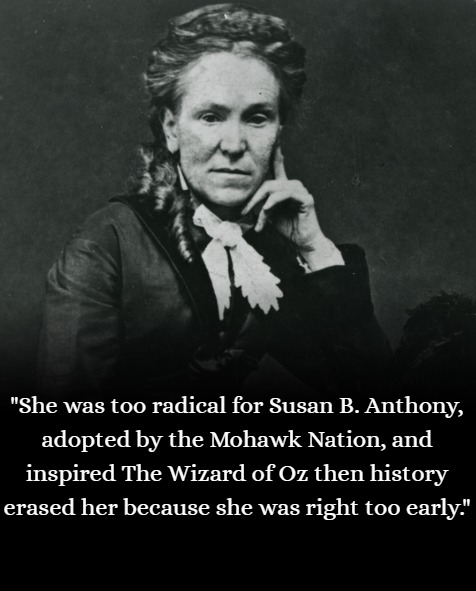
She was too radical for Susan B. Anthony, adopted by the Mohawk Nation, and inspired The Wizard of Oz—then history erased her because she was right too early. March 24, 1826. Matilda Joslyn Gage was born in Cicero, New York. Her father, Dr. Hezekiah Joslyn, was an abolitionist whose home served as a station on the Underground Railroad. As a child, Matilda handed out antislavery pamphlets and listened to Frederick Douglass speak. She wanted to become a doctor. Medical schools refused her because she was a woman. So she became something else. Something more dangerous to the systems that rejected her. The Uninvited Speaker September 1852. The National Women’s Rights Convention in Syracuse, New York. A 26-year-old Gage walked to the podium.
She was the youngest speaker present. No one had invited her. She had simply decided to speak. “Let Syracuse sustain her name for radicalism,” she declared. Her speech was the only one reprinted in full by the newspapers. For the next four decades, Gage stood alongside Susan B. Anthony and Elizabeth Cady Stanton as one of the “Triumvirate” leading the National Woman Suffrage Association. She served as president from 1875 to 1876. She co-authored the first three volumes of the monumental History of Woman Suffrage. Anthony spent so much time at her Fayetteville home that the family called the guest bedroom “the Susan B. Anthony room. “But Gage was different from her colleagues. More dangerous. The Radical VisionAnthony wanted women to vote. Gage wanted to dismantle every institution that kept women subordinate—political, legal, economic, and especially religious. She wrote about coverture laws that erased married women’s legal existence. Under these laws, a wife could not own property, sign contracts, or keep her own earnings. She could not be the legal guardian of her own children.
“How degrading! How humiliating!” Gage thundered. She wrote about “enforced motherhood,” arguing in 1868 that women had been denied “the right to herself… nowhere has the marital union of the sexes been one in which woman has had control over her own body. “She wrote about witch trials—not as medieval superstition, but as systematic warfare against women who threatened male power. In her 1893 masterwork Woman, Church and State, she declared: “The witch was in reality the profoundest thinker, the most advanced scientist of those ages. The persecution which for ages waged against witches was in reality an attack upon science at the hands of the church. “She was saying that the women burned as witches were healers. Scientists. Threats. The book traced how organized religion had shaped laws restricting women’s bodies, property, education, and autonomy for centuries. It documented wife-battering, sexual abuse of children, unequal treatment of prostitutes versus their clients, and the systematic robbery of women’s intellectual labor. Twenty years of research. Hundreds of pages of evidence. A complete indictment of church and state. The suffrage movement tried to distance itself from her. The SplitBy the late 1880s, Anthony wanted to align the movement with Christian organizations to gain broader support. Conservative suffragists believed women’s votes would bring temperance and “Christian values” to politics. They wanted respectability. They wanted allies.
Gage refused to soften her voice. In 1890, the National Woman Suffrage Association merged with its more conservative rival to form the National American Woman Suffrage Association. Gage and Stanton opposed the merger. They saw it as surrender. Gage walked away. She founded the Women’s National Liberal Union, dedicated to preserving separation of church and state and opposing “the doctrine of woman’s inferiority. “The new unified suffrage movement wanted nothing to do with her. But the Haudenosaunee did. She Who Holds the Sky Gage had spent years among the Iroquois nations of upstate New York. She studied their matrilineal culture—where children belonged to their mother’s clan, where women controlled property, where clan mothers held political power and could remove chiefs from office. She wrote about what she witnessed: “Never was justice more perfect; never was civilization higher. Under their women, the science of government reached the highest form known to the world. “When she tried to explain the concept of an “illegitimate child” to a Haudenosaunee friend, the woman was puzzled. “How can any child not be legitimate?” she asked. Gage saw in Indigenous governance a living model of what women’s freedom could actually look like. In 1893—the same year she published Woman, Church and State—the Wolf Clan of the Mohawk Nation offered her something remarkable: Honorary adoption. A seat on the Council of Matrons. A name: Karonienhawi. She who holds the sky. It was one of the highest honors they could bestow on an outsider.
The Wizard Connection Five years later, on March 18, 1898, Matilda Joslyn Gage died in Chicago at the home of her daughter Maud and son-in-law L. Frank Baum. Baum would later write The Wonderful Wizard of Oz. Scholars believe Gage’s ideas about female power shaped his world ruled by women. His concept of “good witches”—revolutionary at the time—echoed her research on how the church had demonized women healers and thinkers. But Gage herself began disappearing from history almost immediately. The Erasure Anthony and Stanton outlived her by years—Anthony by eight. They used that time to shape the historical record. Both burned their papers before death, ensuring The History of Woman Suffrage would stand as the primary “insider” account of the movement they had built together. The conservative suffragists who had pushed Gage out continued writing her out. In 1913, the National American Woman Suffrage Association officially repudiated Woman, Church and State. The book was banned under the Comstock laws. For decades, the suffrage movement was remembered as Anthony’s movement. Sometimes Stanton’s. Almost never Gage’s. The “Triumvirate” became a duo. The Meta-Irony Then, slowly, scholars began finding her again. In 1993, science historian Margaret Rossiter coined a term for the phenomenon of women being denied credit for their intellectual work. She called it “the Matilda effect”—named for a woman who had spent her life documenting exactly that pattern, and then experienced it herself. The woman who documented women being erased from history…
was erased from history. And named for that erasure. In 1995, Gage was inducted into the National Women’s Hall of Fame. Her Fayetteville home is now a museum and center for social justice dialogue. Her gravestone in Fayetteville Cemetery carries the words she lived by: “There is a word sweeter than Mother, Home or Heaven; that word is Liberty. “The Legacy Matilda Joslyn Gage argued that true freedom meant examining every structure that held women down—not just the denial of the vote, but the theology that taught women’s inferiority as sacred truth. She honored Indigenous women as models of political equality when white society called them savages. She defended women accused of witchcraft across centuries of history, insisting they were not evil but educated, not dangerous but daring. She was not erased because she was unimportant. She was erased because she was right too early—and too completely. The suffrage movement eventually won the vote. But Gage had warned that voting alone would never be enough. That any movement willing to compromise with the forces of oppression would only win partial freedom. She who holds the sky saw further than the vote. And history is finally beginning to see her. She co-founded the suffrage movement with Susan B. Anthony. She was adopted by the Mohawk Nation as “She who holds the sky. “She inspired The Wizard of Oz. She documented how women’s work is erased—then was erased herself. The phenomenon of women being denied credit is literally named after her: the “Matilda effect. “And for a century, most of us never knew her name. Share this. Remember her. Say her name: Matilda Joslyn Gage.