PART 1 — The Day She Decided It Was Hers
There are people who believe ownership is something you prove quietly, through time, through care, through the simple act of staying, and then there are people who believe ownership is something you claim loudly, confidently, as if saying something enough times will eventually make it true, and when I first moved into that house at the edge of the neighborhood, I didn’t realize I was stepping into a place where both kinds of people existed, where the boundaries between what was yours and what someone else thought they deserved were not as clearly defined as the fences that marked them. The property itself wasn’t large, not compared to the others in the area, but it carried something most of them didn’t—privacy, space, a line of trees that separated it just enough from the rest of the development to make it feel like its own world, and I had chosen it for that reason alone, not for status, not for appearance, but because it gave me something simple and increasingly rare.
Peace.
For the first few weeks, that peace held.
Neighbors kept their distance in the polite, measured way people do when someone new arrives, conversations brief, interactions surface-level, the kind that don’t require commitment or curiosity. It was exactly what I wanted. No complications. No expectations. Just a place to exist without needing to explain myself.
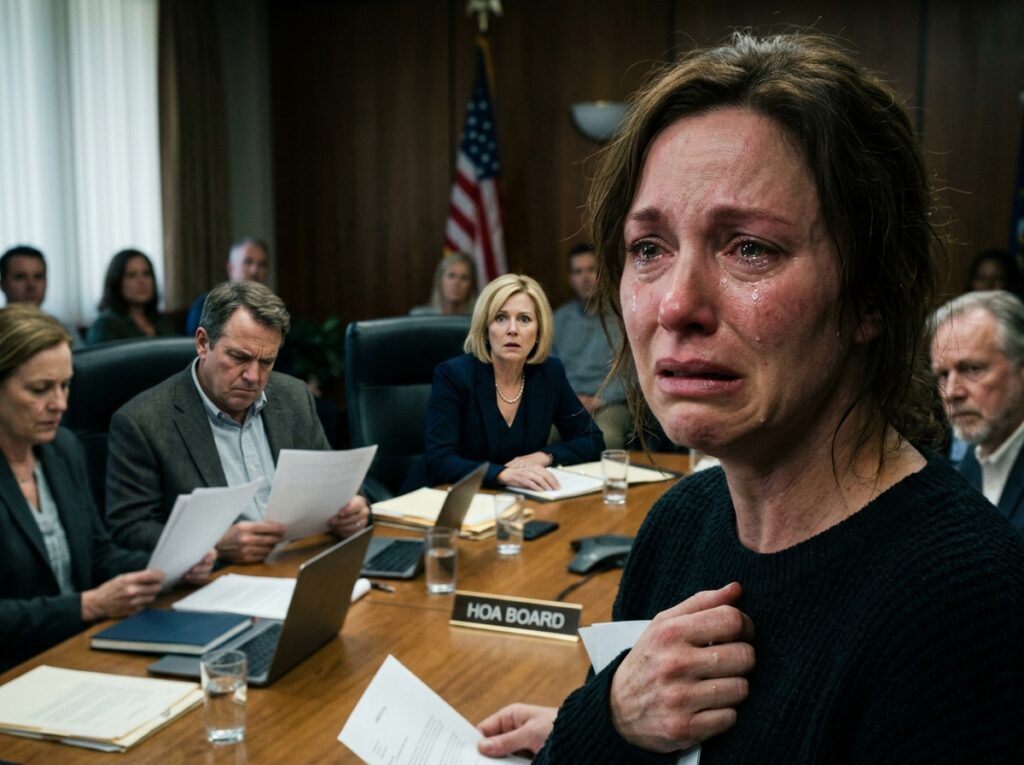
And then she introduced herself.
Not in the way most people do, not with hesitation or casual friendliness, but with the kind of confidence that suggests she wasn’t stepping into my space so much as inspecting it. I saw her before I heard her, standing just beyond the edge of my driveway, her posture rigid, her gaze fixed on the property in a way that felt less like observation and more like evaluation.
“You’re the new owner,” she said when I approached, her tone not questioning, not welcoming, just stating something she had already confirmed.
“I am,” I replied.
She nodded once, slowly, her eyes moving across the yard, the fence line, the trees, as if cataloging details that mattered to her in ways I didn’t yet understand. “I’m with the HOA,” she added, as if that explained everything, as if the title itself carried weight that didn’t need further clarification.
That was the first moment something shifted.
Not dramatically.
Not enough to cause immediate concern.
But enough.
“I’ve been meaning to talk to you,” she continued, stepping slightly closer, closing the distance in a way that felt intentional rather than casual. “There are a few… inconsistencies with your property.”
“Inconsistencies?” I repeated.
She gestured toward the far side of the yard, where the tree line curved slightly inward, creating a natural boundary that didn’t follow the exact symmetry of the rest of the neighborhood. “That section,” she said. “It’s technically part of the shared green space.”
I followed her gaze.
Then looked back at her.
“It’s on my deed,” I said.
Her smile didn’t disappear.
But it changed.
Slightly.
“According to HOA mapping, it falls under community jurisdiction,” she replied, her tone still calm, still controlled, but carrying something underneath it now, something firmer, something that suggested this wasn’t a misunderstanding she intended to leave unresolved.
“That’s not what my paperwork says,” I answered.
She tilted her head just enough to suggest patience, the kind that comes from someone who believes they are in the position to correct you rather than negotiate with you. “Paperwork can be outdated,” she said lightly. “These things get adjusted over time.”
I felt it then.
Not anger.
Not yet.
But awareness.
Because this wasn’t about a minor correction.
It wasn’t about a simple misunderstanding.
It was about something else.
“You’re saying part of my property doesn’t belong to me,” I said.
“I’m saying,” she replied, her voice still smooth, still measured, “that it might be better for everyone if it were reassigned properly.”
There it was.
Not hidden anymore.
Not softened.
Claimed.
As if it had already happened.
I looked past her then, toward the rest of the neighborhood, the houses lined up in neat, controlled order, each one fitting into a pattern that left very little room for anything outside of it, and for the first time since I had moved in, I understood something I hadn’t considered before.
This wasn’t just about land.
It was about control.
And she wasn’t asking.
She was deciding.
“I’m not giving up any part of my property,” I said, keeping my voice even, because raising it would only feed the dynamic she was trying to create.
Her expression didn’t harden.
But it didn’t soften either.
It settled.
Into something certain.
“We’ll see,” she said.
Not as a threat.
Not loudly.
But clearly enough that it didn’t need anything else.
And as she turned and walked away, her steps unhurried, her posture unchanged, I realized something that shifted the entire situation into focus.
This wasn’t a conversation.
It was the beginning of a fight.
PART 2 — The Rules She Thought She Owned
There is a particular kind of pressure that doesn’t come from confrontation, not directly, not in a way that allows you to respond to it cleanly, but instead builds slowly, methodically, through systems that are designed to appear neutral while being used in ways that are anything but, and within a week of that first conversation, I began to understand exactly how she operated, not through what she said to my face, but through what started arriving in my mailbox with increasing frequency, each envelope carrying the same official tone, the same structured language that suggested procedure rather than personal intent, even as the pattern behind them became impossible to ignore.
The first letter was polite.
Almost reasonable.
A notice of “boundary clarification,” requesting documentation to confirm the extent of my property line, framed as a standard review rather than an accusation. It would have been easy to dismiss if it had been the only one, easy to respond, to provide what was needed and move on, but that wasn’t how it worked. The second arrived two days later, less polite, referencing “non-compliance” with HOA standards, citing vague clauses that had nothing to do with what had been discussed, expanding the issue just enough to make it feel larger than it was supposed to be. By the third, the tone had shifted completely, fines introduced not as a possibility, but as an inevitability if corrective action was not taken “within a reasonable timeframe.”
Reasonable.
A word that means nothing when the person defining it has already decided the outcome.
I read each letter carefully.
Not quickly.
Not dismissively.
Because the details mattered.
The language mattered.
And more importantly—
the pattern mattered.
This wasn’t confusion.
It wasn’t administrative error.
It was deliberate escalation, a controlled increase in pressure designed to force movement without direct confrontation, to make resistance feel inconvenient, expensive, exhausting enough that compliance would seem easier than continuing to push back.
And for a moment—
I understood why it worked.
Not on me.
But on others.
Because systems like this aren’t built to win arguments.
They’re built to wear people down.
I didn’t respond immediately.
Not because I didn’t intend to.
But because responding too early, too directly, would only feed into the structure she had already set, would place me exactly where she expected me to be—reactive, defensive, operating within the rules she believed she controlled.
Instead, I observed.
The neighborhood had changed.
Not openly.
Not in ways that would be obvious to someone passing through.
But in the small details.
The way conversations stopped when I approached.
The way certain neighbors avoided eye contact, their movements just slightly more deliberate, as if they were aware of something they didn’t want to be associated with.
And then—
there were the others.
The ones who watched.
Not with judgment.
But with caution.
One of them spoke to me eventually.
Not in the open.
Not in a way that could be seen.
But quietly, at the edge of the street, in a moment that felt less like a conversation and more like a warning.
“She’s done this before,” he said, his voice low, his gaze shifting briefly toward the direction of her house before returning to me.
I didn’t ask who.
I didn’t need to.
“With that section of land?” I asked.
He shook his head.
“With anything she can reclassify,” he replied. “She finds something that isn’t perfectly documented, something that overlaps just enough to create confusion, and then she pushes. Hard.”
“And people give in?” I said.
He let out a short breath, something between frustration and resignation.
“Eventually,” he said. “It’s easier.”
That was the moment everything became clear.
Not just what she was doing—
but why she was so confident doing it.
Because she wasn’t used to resistance.
She was used to time doing the work for her.
I nodded once, more to acknowledge what I already understood than to confirm anything new, and he hesitated for a second, as if deciding whether to say more.
“Just be careful,” he added finally. “She doesn’t like being challenged.”
I almost smiled at that.
Not because it was wrong.
But because it missed something important.
Neither did I.
The next notice came with a fine.
Not large.
Not significant.
But symbolic.
A marker.
A line drawn.
And this time—
it wasn’t just paper.
A small sign had been placed at the edge of the disputed area, subtle but visible, labeled as “HOA Managed Green Space,” as if the decision had already been made, as if ownership could be redefined simply by declaring it.
I stood there for a moment, looking at it, taking in the way it had been positioned, the way it shifted perception without requiring agreement.
It was smart.
Strategic.
And completely wrong.
I reached down, pulled it out of the ground, and set it aside.
Not aggressively.
Not dramatically.
Just… removed.
Because that was all it was.
An assumption.
And assumptions don’t hold weight—
unless you let them.
The next move wouldn’t be hers.
Not this time.
Because now—
I understood the game.
And I wasn’t playing it the way she expected.
PART 3 — The Line She Shouldn’t Have Crossed
There is a difference between reacting to pressure and preparing for it, between answering what is being done to you and understanding why it is being done in the first place, and once I saw the pattern clearly, once I understood that this wasn’t about a misunderstanding that could be corrected but a system being used deliberately to reshape ownership through persistence rather than proof, the situation stopped feeling like a conflict and started feeling like something else entirely—predictable, structured, and most importantly, beatable. Because people who rely on control tend to repeat themselves. They follow the same steps. They assume the same outcomes. And when you know the pattern, you don’t have to fight the moment. You only have to position yourself for the point where it breaks.
The paperwork I had wasn’t just sufficient.
It was complete.
Original deed documentation, survey records, county filings that predated the HOA itself—details that most people never needed to think about because their ownership was never challenged in a way that required them to prove it beyond the surface. But I didn’t rely on what I had alone. I went further, pulling archived maps, cross-referencing boundary adjustments from years before I ever moved in, tracing the line of that tree-covered section through every recorded change the neighborhood had undergone since it was first developed.
And the truth—
wasn’t complicated.
That land had never been part of the shared green space.
Not technically.
Not historically.
Not legally.
The HOA map she was referencing wasn’t incorrect.
It was altered.
Subtly.
Just enough to create overlap.
Just enough to introduce doubt.
Just enough that someone without the time or knowledge to dig deeper might accept it as accurate.
But accuracy, when it’s built on omission, doesn’t hold up under scrutiny.
And she had made one mistake.
She assumed I wouldn’t look.
The notice for the HOA meeting arrived three days later, formal, structured, exactly as expected. A “review session” to address the ongoing compliance issues, scheduled in a way that suggested neutrality but carried an underlying assumption that the outcome had already been decided. These meetings weren’t designed for resolution. They were designed for confirmation, for reinforcing decisions that had been quietly shaped beforehand.
I didn’t respond.
I didn’t argue.
I simply prepared.
When I arrived that evening, the room was already arranged, chairs set in neat rows, a long table at the front where the board members sat with the kind of composure that comes from believing you are operating within authority that won’t be challenged. She was there, of course, positioned slightly forward, not at the center but close enough that her influence was clear without needing to be stated. Her posture carried the same confidence as before, the same quiet certainty that this was just another step in a process she had completed successfully more than once.
She saw me.
And for a brief moment—
she smiled.
Not warmly.
Not welcoming.
But with recognition.
The kind that says you showed up exactly where I expected you to.
The meeting began the way these things always do, with formalities, with language that creates the illusion of fairness while guiding attention toward a predetermined conclusion. They outlined the “issue,” referenced the documentation she had provided, spoke in terms that suggested clarity where there was none, each word reinforcing the idea that this was a matter of compliance rather than dispute.
And then—
they gave me the floor.
“Do you have anything you’d like to add?” the board chair asked, his tone neutral, practiced, the question more procedural than genuine.
I stood slowly, not out of hesitation, but out of control, because control in a room like this isn’t about speed, it’s about presence, about choosing the moment you shift the direction of the conversation rather than reacting to it.
“I do,” I said.
The room settled.
Not completely.
But enough.
I placed the documents on the table in front of them, not dramatically, not forcefully, just enough to shift the focus, to introduce something that hadn’t been part of the structure they had prepared for.
“Before we continue,” I added, my voice even, measured, “I think it’s important that we clarify something.”
She leaned back slightly, her expression unchanged, her confidence intact, because from her perspective, this was expected. Resistance always came at this stage. Objections. Arguments. Attempts to delay what she already believed was inevitable.
“What we’re discussing,” I continued, “is not a matter of interpretation.”
I opened the first document.
The original survey.
Then the next.
County records.
Historical zoning maps.
Each one placed carefully, deliberately, forming a sequence that didn’t need explanation to begin shifting the room’s understanding.
“This land,” I said, gesturing toward the area in question, “has been part of my property since before this HOA existed.”
The board members exchanged glances.
Small.
But noticeable.
Because now—
something didn’t align.
She didn’t interrupt.
Not yet.
But I saw it.
The first crack.
Not in her composure.
But in her expectation.
“And the map currently being referenced,” I added, sliding one final document forward, “was modified.”
That was the moment.
The one she hadn’t planned for.
The one she couldn’t control.
“Excuse me?” she said, her voice sharper now, the calm beginning to fracture at the edges.
I didn’t look at her.
I didn’t need to.
Because the room had already shifted.
“This version,” I said, tapping the altered map, “doesn’t match any official county filing.”
Silence followed.
Not the kind that fades quickly.
But the kind that holds.
Because now—
this wasn’t about compliance.
This was about credibility.
And hers—
was starting to slip.
FINAL PART — The Power She Thought Was Hers
There is a point in every conflict where the outcome stops being uncertain, where the weight of truth begins to press down in a way that no amount of confidence or control can hold back, and as the silence settled over that room, heavier now than at any point before, I could feel that moment taking shape, not in anything dramatic or explosive, but in the subtle, irreversible shift of attention, the kind that moves away from authority and toward evidence without needing to be directed. The board members weren’t looking at her anymore. Not fully. Their focus had shifted, drawn to the documents in front of them, to the discrepancies that no longer aligned with the version of events she had presented so carefully.
“This doesn’t match our current records,” one of them said, his voice quieter than before, less certain, as if he were speaking into a situation that had already begun to move beyond his control.
“Because your current records were updated incorrectly,” I replied.
The words weren’t accusatory.
They didn’t need to be.
Because the implication carried more weight than any tone ever could.
She leaned forward then, her composure tightening, her control no longer effortless, the smooth confidence she had relied on beginning to fracture in visible ways. “That’s not accurate,” she said quickly, her voice sharper now, faster, as if speed might restore authority. “The map was revised during the last community zoning adjustment. It was approved—”
“By who?” I asked.
I didn’t raise my voice.
I didn’t interrupt.
I simply asked.
And that was enough.
Because questions, when they land at the right moment, don’t challenge.
They expose.
She hesitated.
Not long.
But long enough.
Long enough for the room to notice.
“It went through standard HOA review,” she replied, but the answer lacked something now, something it had carried earlier in the conversation—certainty.
“That’s not what I asked,” I said.
Another pause.
This one longer.
Because now—
the structure she had built didn’t have a place for this question.
The board chair cleared his throat, shifting slightly in his seat, his attention moving between the documents and her in a way that suggested something fundamental had changed. “Do we have documentation of that approval?” he asked, not aggressively, not confrontationally, but with a tone that carried something new.
Doubt.
She turned to him quickly, too quickly, her response immediate but no longer controlled. “It was processed internally,” she said. “These things don’t always require—”
“Formal record?” he finished.
The room stilled again.
Because now—
it wasn’t just me questioning her.
It was them.
And that was the part she hadn’t prepared for.
Her eyes moved across the table, searching, calculating, trying to regain footing in a space that was no longer stable, and for the first time since this began, I saw it clearly.
Not confidence.
Not control.
But strain.
Because systems like the one she relied on only work as long as no one pushes beyond their surface, as long as no one forces them into a space where they have to justify themselves under scrutiny.
And she had never been forced into that space before.
Until now.
“The records we have on file are…” another board member began, flipping through the documents, his expression tightening as he compared what was in front of him with what he expected to see. “These don’t align with the county filings.”
No one spoke after that.
Not immediately.
Because silence, when it follows a realization like that, carries something final.
Something that doesn’t need to be explained.
She sat back slowly, the movement controlled but no longer confident, her posture shifting in a way that suggested retreat rather than authority, the first real sign that the position she had held so firmly had begun to collapse beneath her.
“This is being misinterpreted,” she said, but the words didn’t land the same way anymore. They didn’t carry weight. They didn’t direct the room.
They floated.
And then—
they fell.
Because no one followed them.
No one agreed.
No one reinforced them.
The board chair exhaled quietly, his gaze steady now, no longer uncertain, no longer divided. “We’re going to need to review this further,” he said, his tone formal again, but different, grounded in something more solid than before. “Effective immediately, all fines related to this matter are suspended.”
That was the moment.
Not loud.
Not dramatic.
But decisive.
Her head snapped slightly toward him, the reaction immediate, instinctive, as if she hadn’t expected the shift to come so quickly, so completely. “You can’t just—” she started, but the words cut themselves off, because she realized something in that instant.
She wasn’t in control anymore.
Not of the board.
Not of the situation.
Not of the narrative.
“This will be handled properly,” he continued, not raising his voice, not escalating, but leaving no room for argument.
And just like that—
it was over.
Not the process.
Not the formalities that would follow.
But the outcome.
Because everything that came after this moment would only confirm what had already been decided.
She didn’t say anything else.
Not because she didn’t want to.
But because she couldn’t.
Because there was nothing left that would hold.
The room began to shift again, not back into what it had been before, but into something quieter, more deliberate, the kind of movement that follows resolution rather than conflict. People stood. Papers were gathered. Conversations resumed, but not in the same tone, not with the same assumptions.
And her—
she stayed seated for a moment longer than the rest.
Just long enough.
For it to be seen.
Not as power.
But as loss.
I didn’t look at her again.
I didn’t need to.
Because this had never been about humiliation.
It had been about something simpler.
Ownership.
Not just of the land.
But of the truth.
And as I stepped out of that room, the air outside cooler, clearer, untouched by the tension that had filled the space behind me, I felt something settle into place—not satisfaction, not victory in the way people often describe it, but something quieter.
Finality.
Because the thing about people who try to take what isn’t theirs—
is that they rely on silence.
On assumption.
On the belief that no one will push back far enough to expose what’s underneath.
And sometimes—
all it takes—
is one person who does.
THE END.!