📖 PART 1 — She Took My Purse Like She Was Taking My Life
There are moments when disrespect doesn’t arrive with shouting, but with a kind of quiet certainty that makes it more dangerous than anger ever could, and that morning, when my daughter reached over and slipped the strap of my handbag from my shoulder as if it were something I had already outgrown, I understood that what was happening in my kitchen was not a misunderstanding, not even an argument in the usual sense, but an attempted transfer of power, the kind that hides behind concern and calls itself love while reaching straight for control. She did not ask if she could look inside. She did not hesitate. She opened the clasp, sifted through my wallet, and told me in the calm, polished tone of someone who had already decided the outcome that I no longer needed to manage household spending, that from now on she would handle it for me, as if I were a problem to be solved rather than a mother standing in her own home.
I told her, quietly, that my purse was not hers, but she moved through my things as though she had already been granted authority somewhere beyond me, somewhere I had not been consulted, and when she slid my debit card into the back of her phone case, she did it with the confidence of someone who believed family itself was permission. She said she had already spoken to the bank. She said they knew she was family. She said everything would be easier this way. And the word easier hung there between us with the sharp, clean smell of a lie dressed up to look helpful. I did not shout. I did not grab the card back. I made tea instead. That is what people fail to understand about calm. Calm is not surrender. Calm is often the last thing standing between you and someone else’s version of your life.
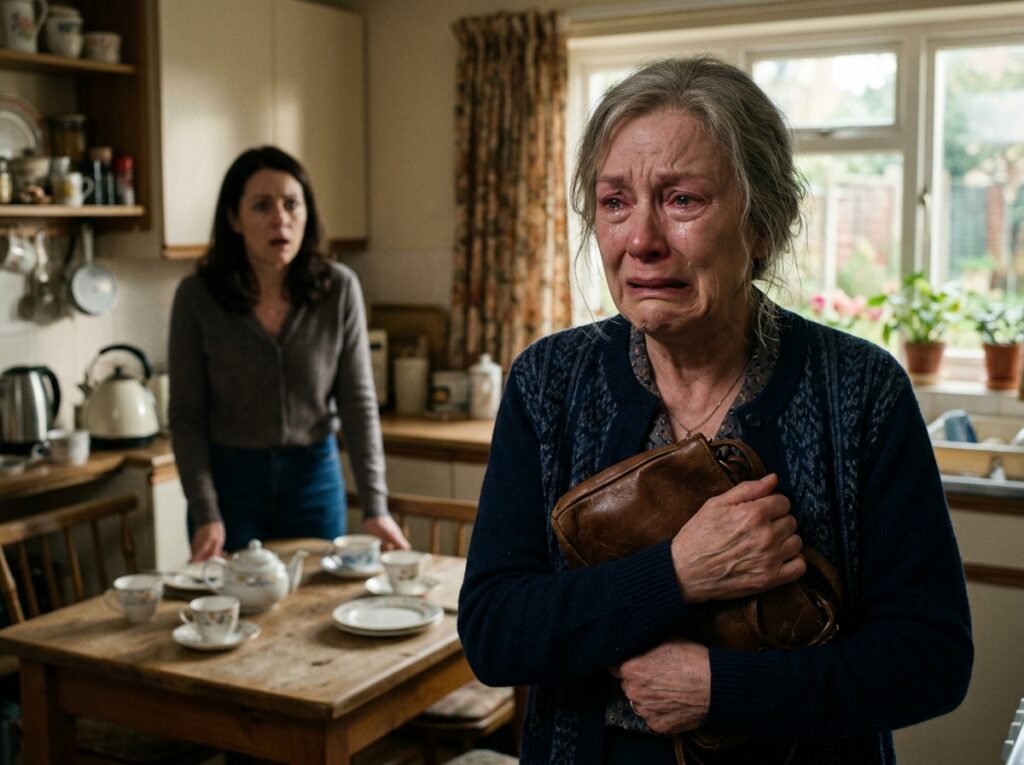
She kept talking while I poured hot water over tea leaves, speaking about streamlining expenses, setting alerts, raising limits, making sure I didn’t forget things anymore, and in each sentence there was the same hidden insult: that I was no longer trustworthy in my own affairs, that age had reduced me into someone who needed to be managed. I looked at her hands as she spoke—well-kept, decisive, expensive hands—and thought about how long it had been since they had held mine without wanting something in return. She told me I would have an allowance. She said I could rest. She said she was only doing it because she cared. And I let her believe, for a little while longer, that I was listening from inside the role she had written for me. Then she left with my purse under her arm and my card tucked away, promising to come back later so we could go to the bank together, because in her mind the matter had already been decided.
When the door closed behind her, silence sat down across from me at the kitchen table. I drank my tea while it was still hot and let the house settle. Then I found the purse she had brought the week before hanging from the chair by the window, and inside it I found the envelope she had forgotten—a list of questions I myself had written for the bank the night I first understood that being old in this world often means people begin measuring how easily you can be rearranged. Beneficiaries. Transfer limits. Authorizations. What to do if someone decides you are easier to manage than hear. That list was all the confirmation I needed. I put on my coat, locked the house behind me, and walked to the bus stop with my shoulder strangely light where the purse used to hang and my mind clearer than it had been in weeks.
📖 PART 2 — She Thought She Was Early, But I Was Already Ahead
The bank smelled like printer ink, hand lotion, and lemon polish, and by the time I stepped inside, I was no longer acting out of panic but out of precision. I told the teller I wanted to close my checking account and move the money somewhere safer, and when she informed me that it was a joint account with my daughter and that two withdrawals had already been made that week—one yesterday, one that morning—I finally understood the source of Ava’s confidence. She hadn’t just planned to take over. She had already started. That stung, more than I let show, but sting is not the same thing as defeat. I told them to freeze the account immediately and remove her authorization. Ten minutes later, I was sitting across from the branch manager, a silver-haired man who had known my late husband back when George used to deposit side-job money for what we called the roof fund, and for the first time in months, someone was speaking to me not like I was fading, but like I was fully present and entitled to protect what was mine.
He asked if I wanted stronger protections than simply moving the balance, and that is how the trust began—not as revenge, not as punishment, but as structure, the kind that cannot be sweet-talked, guilted, or quietly rearranged. He explained that I could place the funds in my own name with a designated beneficiary, and I thought immediately of Adam, my grandson, who still came by on Sundays for pie and tea without treating me like a vault with legs. I thought of his steady kindness, the absence of calculation in him, the simple fact that he came to me as I was rather than as a source of leverage. I told the manager I wanted Adam as beneficiary, and when he asked if I wanted to include the house, I nearly said no—until I remembered all the years of Ava’s little comments about downsizing, about centralizing, about how too much space was wasted on one old woman. So I said yes. The house too.
I left the bank with a temporary debit card, legal paperwork, and the first real sense of breath returning to my body. On the bus ride home, the town passed by in ordinary fragments, and the ordinariness of it felt almost merciful. By the time I walked back through my front door, my purse had been returned to the hall table, emptied except for a crumpled receipt, the coins gone as if even the smallest weight had been worth taking. At two o’clock, the phone rang. Ava told me, brightly and falsely, that she had gone ahead and paid some bills to help out. I thanked her, then informed her that I had already taken care of my banking and that everything was in order now. The pause on the other end told me more than her words ever could. She had expected access. Instead, she found absence.
That week I did not tell Adam anything. He came over with cinnamon rolls, talked about school, and laughed about group projects while I poured him tea and protected the ordinary shape of Sunday from the ugliness that had started to gather around it. But behind that ordinary surface, I was building walls that didn’t look like walls at all. I called the lawyer the bank recommended. I made lists. I copied documents. I prepared. When Ava phoned again with a softer strategy—automatic transfers, convenience, peace of mind, all the language people use when they want your compliance to look like your own idea—I let her speak until she revealed herself fully. Then I told her that my affairs were mine and that there was nothing for her to manage. She tried guilt. I gave her clarity. And clarity, I have learned, is infuriating to people who planned on confusion.
📖 PART 3 — They Came for My Money, My House, and My Obedience
The pressure did not end with Ava. It widened. Garrett appeared one afternoon without patience or apology, demanding to know whether I understood the mess I had made. Marissa was furious. Toby was stranded. Payments were due. Responsibilities had shifted back onto shoulders that had grown used to leaning on mine. I stayed seated at the kitchen table with my hands around my teacup and listened while he tried to dress his need in the language of family. He said they were overwhelmed. He said we were family. He said I could not pull the rug out from under my own children. But what I heard beneath all of it was simpler: we depended on you, and we assumed that meant we always could. When I reminded him that he had sacrificed me before—letting me be excluded, letting me be the easy loss to keep peace in his own home—he had the decency to look uncomfortable, but not enough to stop asking for what he wanted.
I told him that I did not want the house I had paid for to become my leash, and that if losing his own forced him to remember how to stand on his own feet, perhaps that would be a lesson worth learning. He did not like that. Few people do when the ground shifts under them and they cannot blame the floor. After he left, I stood at the window and looked at George’s roses blooming stubbornly in the late light, beautiful and unapologetic, and I thought that if a rose can survive with so little tending, so can I. The next day I returned to the bank to review the trust paperwork, and the language gave me comfort in a way softness never could. No loopholes. No assumptions. No shortcuts. My house, my savings, even the little parcel of land George bought years ago were now moving into protection.
The lockbox came next. Fresh envelopes. A ledger. Utilities. Property taxes. Personal savings. Each category given its place. Each document tucked where it belonged. The machine kept blinking with messages, but I deleted them without listening. When the bank later informed me that someone had tried to use an old authorization at another branch and had been declined, I did not need names. I already knew. By then, Ava’s tactics had changed from force to sweetness, from grabbing the purse to arriving with flowers and a softer voice, from “You don’t need this anymore” to “I don’t want to be that woman.” But sweetness used after force is still strategy, at least at first. She brought the purse back and said she had been scared. She said she thought if she did not act, someone would take advantage of me. Then, to her credit, she admitted what mattered most: that in trying to protect me from imagined theft, she had become the thief herself.
I did not hug her. Not then. I gave her markers instead. Call before coming over. Don’t raise your voice in my house. Don’t touch my mail, my purse, my keys. Don’t speak about my mind as if I am not in the room. Don’t pull Adam into sides. She said she understood. Maybe she did. Maybe she only understood enough to know she had lost. But whether her remorse was fully mature yet mattered less than something else: the boundary had finally been named aloud. And once a boundary is named, even imperfect people have to decide whether they will keep crossing it or begin walking around it.
📖 PART 4 — The Truth Could Not Stay Hidden Forever
There comes a point in every family story where silence stops protecting anyone and starts serving the wrong person, and by the time Adam sat across from me at the kitchen table with pie cooling between us, I knew we had reached that point. I told him everything. Not the softened version. Not the edited one shaped for peace. Everything. Ava taking my purse. The withdrawals. The bank. The trust. The calls to neighbors. The quiet attempts to build a story around me in which I was forgetful, vulnerable, influenceable, a woman whose life was already halfway available for takeover if enough people nodded in agreement. He listened without interrupting, his jaw tightening as the picture took shape. Then he told me that Ava had been asking him strange questions too—whether I seemed confused, whether I lost things, whether I sounded “like myself.” She wasn’t just gathering access. She was gathering witnesses.
That knowledge changed something in me. Not because it frightened me, but because it confirmed that what I was resisting was not one bad decision or one panicked act. It was a campaign of permission-building, the slow, polite construction of a reality in which taking from me could later be described as helping me. I told Adam I needed one person in this family to know exactly where the line had been drawn, and he told me he believed me. Those words settled somewhere deep, somewhere years of noise had never reached. After he left, I wrote two simple words and slipped them into the lockbox with the trust documents: Adam knows. I wanted a record. Not legal. Human. A proof that the truth had not remained mine alone.
A few days later Ava returned with Michael. They arrived together not to reconcile but to apply pressure in pairs, to create the impression of reasonableness by multiplying voices. They spoke of fear, fairness, impracticality, legacy. Michael tried to make the trust sound unkind. Ava tried to make it sound paranoid. Together they tried to suggest that my refusal was not clarity but stubbornness, not self-protection but selfishness. I told them plainly that hurt does not only come with raised voices. Sometimes it comes with pens and withdrawal slips and the assumption that fear can be dressed up as care. That line stopped the room. Because truth, when spoken simply, often does more damage than anger ever could.
When they left, they had gained nothing—not my money, not my house, not even the comfort of making me doubt myself. The final signing with Ruth made everything official. Every page marked. Every signature mine. Every clause closed against the sort of family pressure that relies on vagueness to function. The house, the savings, the little parcel of land—all of it was secure and tied to Adam as sole beneficiary. I came home lighter than I had felt in months, not because the family storm had passed, but because the roof over me no longer depended on their moods. A week later, the bank informed me someone had tried once again to use an old authorization. Declined. Flagged. Documented. The machine answered when the phone rang, and message after message arrived from Ava asking me to reconsider, insisting she was not after my money, rehearsing concern so carefully that I could almost admire the effort if it hadn’t been aimed straight at my freedom.
📖 PART 5 — She Returned My Purse, But Not to the Same Woman
The final time she came, she arrived with tulips from the supermarket and uncertainty in her face. There was no performance left sturdy enough to hide behind. She stood on the porch holding my old leather purse in both hands and admitted she no longer knew how to stand there—whether as my daughter or as a stranger. I told her she could stand as she was and say what she had come to say. She placed the purse gently on the hall table and told me it had always been mine. Then, finally, she said the part that mattered: she had been afraid. Afraid that someone would take advantage of me. Afraid that if she didn’t act first, she would lose control. Afraid in ways that turned her into exactly the thing she claimed she was defending me from. Fear makes fools of people, yes, but more dangerously, it makes them justify themselves.
I listened. I did not rush to forgive. I did not hand her easy absolution simply because she had arrived with flowers and a softened voice. I told her that a way back is not a circle but a road with markers, and if she wanted to walk it, she would know by how she behaved when no one was watching. I gave her terms, simple and unadorned. Call before coming over. No raising her voice in my house. No touching my things. No speaking about my mind as if I weren’t present. No using Adam as a messenger or a witness or a tool. We could have tea. We could talk about the garden. We would not talk about my accounts. She nodded. She said she could do that. For the first time in weeks, she did not sound like she was auditioning for forgiveness. She sounded tired. Human. Frightened of herself.
When she asked if she could hug me, I said not today. That was not cruelty. It was structure. Boundaries bruise when they are new, I told her. Later, they hold you up. After she left, I put the flowers in the sink, the purse on the closet shelf, and made the good tea Adam brings. The street carried on in its ordinary way—children, bicycles, barking dogs, Mr. Keegan watering tomatoes like they might applaud him—and after a while Adam came by and sat on the step below mine, easy in his own skin, kind without performance. He asked if she had come. I told him we had reached an understanding. He did not pry. He simply sat beside me and later, when he stood to leave, kissed my cheek and said he was proud of me. Those words went somewhere deep.
That evening I slipped two notes into the places that mattered. One into the lockbox with the trust documents: Home placed in trust. Choices made clear. Love does not require proof of funds. The other into the purse on the closet shelf: If you are opening this without asking, close it. Then try again with the doorbell. Then I washed my dinner plate, turned the key in the front door, and stood for a moment in the quiet house that had held my best and worst days. I am not a martyr. I am not a judge. I am an old woman who finally learned that dignity is not something other people grant when they feel generous enough. It is a line you draw and hold, even when your hand shakes. I loved my daughter before she crossed that line. I love her now. But love is not permission. And peace, real peace, sounds a lot like a clean floor creaking under your own weight, a kettle slowly coming to a boil, and a life that belongs—fully, finally—to you.
THE END.!