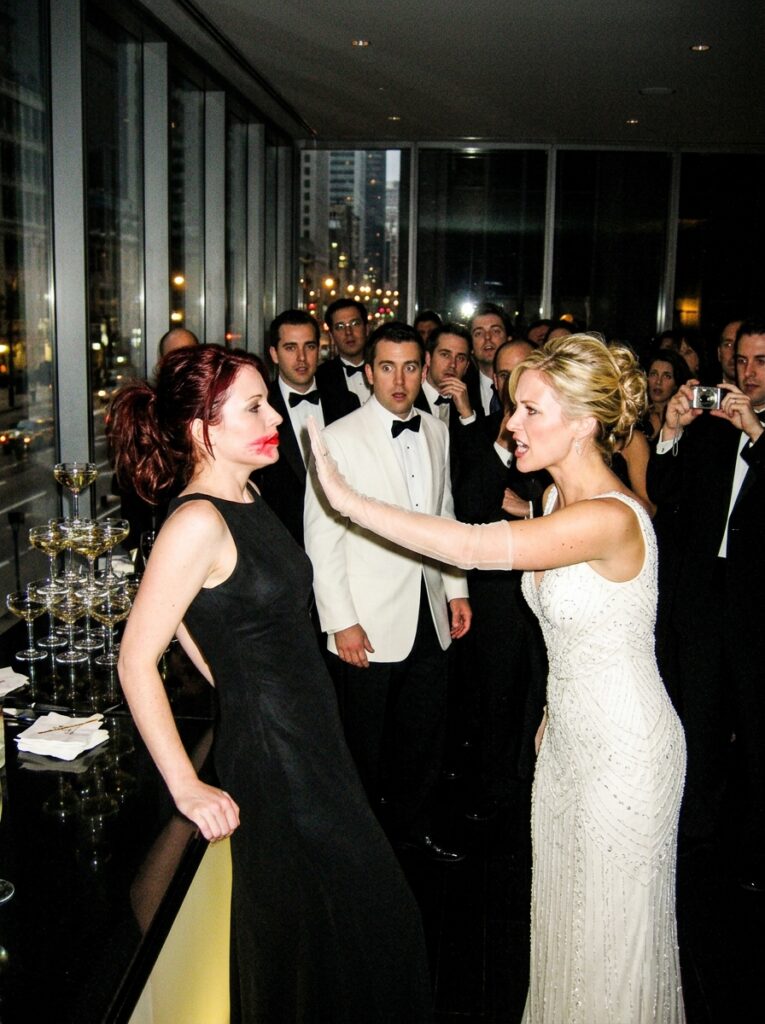
At my step-sister’s wedding, with 500 guests, the same family that had pushed me out at 16 allowed me to stand silently on the edge of the dance floor, as if I didn’t belong. Then the bride walked right up, mocked the dress I was wearing, hit me hard enough to make everyone around her turn and call me a loser while the people around us laughed. I didn’t argue. I didn’t raise my hand to my cheek. I just stood there, letting her believe I was still the powerless girl they had once abandoned. The illusion lasted until her fiancé walked between us, looked at me as if a name had clicked, and asked something that froze the entire room: “Do you know who she is?”
The hit made my face turn to the champagne display. In a moment, everything blurred into light. Gold from the chandeliers. Silver leapt from the glass walls. Rows of glasses caught it all like sparks. My cheeks burned instantly, a fierce heat spread beneath my skin. Someone was gasping. Elsewhere, a laugh broke out. Then more laughter followed. Not everyone joined in, but enough. Enough smiles hidden behind glasses, enough whispers, bringing the same excitement people get when a formal event turns into a spectacle. The elegance of the room had turned to something colder and more tangible. My step-sister stood there, her hands still half raised, as if even she hadn’t imagined how satisfying it would feel to humiliate me in front of everyone.
“You don’t belong here,” she said. Her voice came easily. It always had. Some people attract others with their gentleness. Tessa never needed it. The room turned to her voice whether they wanted it or not. She had always known how to act. As a teenager, she could cry on cue. As an adult, she could make people believe anything that suited her. Now, standing in a dress that cost more than most people’s rent, she still had the same skill she had always relied on: turning her cruelty into someone else’s humiliation.
I didn’t move. Didn’t touch my face. Didn’t speak. That made her more uncomfortable than anything. If I had reacted, she would have been able to control the moment. Anger or tears would have fit her script perfectly. But silence did something different. It forced people to see what was happening, and she hated that.
Around us, the room began to change. The conversation faltered. The music faltered and stopped. Even the staff slowed down, sensing that something had changed. Tessa stepped closer. Her veil trembled slightly. The diamonds caught the light. Under her perfect makeup, the colors rose too quickly, anger mixed with everything else.
“Look at you,” she said loudly. “Do you really think you can stand here with people like us?”
More laughter erupted nearby. People were quick to laugh when someone else was already being judged for them. I stayed where I was, my glass of water still in my hand, untouched. And I thought how easy it was for a room to accept brutality when it came from a bride.
Then a man’s voice cut through everything. “Do you know who she is?”
The silence died down suddenly. Not gradually. Completely. The question didn’t just silence the room. It changed the air itself. Tessa turned first, the distraction turning into confusion. I turned slowly, already knowing that this was the moment when everything would fall apart into before and after.
Dominic Rhodes stood a few steps behind her. One hand on the chair, the other tense at his side, as if he had moved without thinking. He no longer looked like the charming groom he had been, the one who had shaken hands and smiled for a photo. Now he looked shaky. And he was looking at me. Not at Tessa. Not at the guest. At me.
He sighed. “Mrs. Thorne.”
A whisper echoed through the room. You could feel people recalculating, adjusting what they thought they understood. Tessa laughed softly. “What are you doing?”
He ignored her. “Mrs. Thorne,” he said again, this time for sure.
I thought about speaking. I could end it there, deny it, leave him and the others with what was about to unfold. I could have let Tessa walk away without realizing it. But my cheeks were still hot. And somewhere in my memory, I heard another voice from years ago telling me to leave. So I remained silent.
Finally, Dominic looked at her. “What are you thinking?” he asked quietly. “What did you just do?”
His calm voice made her more uneasy than angry. “What are you talking about?” she cried. “It’s nothing. She just…”
“Stop.” Softly. Controlled. Finally. Then he looked around the room. Looking at the guests. In a world where Tessa had always believed she owned. When he spoke again, it was for everyone.
“The woman you just slapped,” he said, “is Cassidy Thorne.” The silence deepened. Then he finished. “She owns Thorne International Holdings.”
Everything changed in an instant. The same people who had just laughed were now staring, trying to reconcile the woman in the simple navy dress with the name they knew from Forbes lists, billion-dollar mergers, and quiet philanthropy that shaped industries.
Tessa’s face drained of color. “You’re lying. That’s impossible. She’s… she’s nobody. Dad kicked her out when she was sixteen!”
Dominic’s voice stayed steady, but his eyes held fury. “She’s the majority shareholder of the company that just acquired my firm last month. The woman whose name is on the building where I work. The one who turned a small family logistics business into a global empire after her own family threw her away.”
Gasps rippled through the 500 guests. Phones that had been recording the slap for laughs were now lowered in shock. The bride’s perfect day cracked wide open.
I finally spoke, my voice calm and clear, carrying across the silent ballroom. “Hello, Tessa. You look beautiful. Congratulations on your wedding.”
The words were polite, but they landed like ice.
My stepfather, Richard, pushed through the crowd, face pale. “Cassidy? Is it really you?”
I met his eyes—the same eyes that had told me at sixteen I was “too difficult” and needed to leave so Tessa could have the “stable home she deserved.” “Yes, Richard. It’s me. The difficult one who built something instead of tearing others down.”
What followed was not just a wedding interrupted. It was the unraveling of years of lies, abandonment, and hidden power.
Let me take you back to where it truly began.
I was thirteen when my mother married Richard. Tessa, his daughter, was eleven. From the first day, I was the outsider. My mother had passed away two years later from cancer, leaving me with a stepfather who saw me as a burden and a stepsister who saw me as competition. At sixteen, after I refused to give up my late mother’s scholarship fund for Tessa’s “dream trip to Europe,” Richard packed my bags and drove me to a distant aunt’s house. “You’re old enough to figure it out,” he said. “Tessa needs focus.”
I slept on couches, worked night shifts at diners, and finished high school with perfect grades while living on ramen and determination. College was community college by day, coding bootcamps by night. I started Thorne Logistics as a side hustle tracking shipments for small truckers. By twenty-five, it was a tech platform revolutionizing supply chains. By thirty, Thorne International Holdings was a Fortune 500 company. I never changed my last name. I kept “Thorne” as both armor and reminder.
I stayed silent about my success. No interviews. No social media. I attended family events rarely, always in simple clothes, always on the edge. They assumed I was still struggling. I let them.
Until Tessa’s wedding.
After Dominic’s revelation, chaos erupted. Tessa screamed, “This is my day! Get her out!” But no one moved to remove me. Instead, guests who had laughed at the slap now approached with nervous apologies.
Dominic pulled Tessa aside, but their argument carried. “You slapped the woman whose company signs my paycheck. Whose foundation funds the orphanage I volunteer at. I can’t marry someone capable of this.”
The wedding was canceled that night. Dominic walked away, not out of anger at the slap alone, but at the years of stories Tessa had told him about her “troubled stepsister” who was jealous and unstable.
In the weeks that followed, the story exploded online. Someone had recorded the entire incident. The video titled “Bride Slaps Mystery Guest… Turns Out She’s a Billionaire CEO” went viral with over 120 million views across TikTok, Instagram, X, and Facebook. Comments flooded in from millions: “Never judge by the dress.” “This is why you stay kind.” “Golden child syndrome destroyed their family.”
I received thousands of messages from people who had been the “forgotten sibling,” the stepchild pushed aside, the one who succeeded quietly. Their stories broke my heart and fueled my purpose.
I finally spoke publicly in a short video from my office. “At sixteen, my family chose comfort over me. I chose resilience. To every overlooked child: Your value isn’t decided by those who abandoned you. Build your own table. And when they try to humiliate you at theirs, remember—silence can be the loudest response.”
The response was overwhelming. I launched the Thorne Rising Foundation—scholarships, mentorship, and emergency housing for teens kicked out of blended families. In the first year, we helped over 2,500 young people finish school and start businesses. Noah, a quiet boy I mentored who reminded me of myself, now runs a successful tech startup and calls me “big sis.”
Richard reached out six months later. He was alone; Tessa had cut him off after the wedding fallout ruined her social circle. “I was wrong, Cassidy. I failed you.”
I met him at a quiet café. “You did. But I didn’t fail myself. I forgive you, not for you, but for me. Tessa needs to do her own work.”
Tessa never fully apologized. She sent a generic text blaming “wedding stress.” I blocked her. Some bridges are better left burned.
Dominic and I became friends. He left the company gracefully and now advises startups funded by my foundation. “You taught me real power doesn’t need to shout,” he said one evening over coffee.
Today, at thirty-four, I stand on stages speaking to thousands about family trauma, financial independence for women, and breaking generational cycles. My simple navy dress from that wedding hangs in my closet as a reminder. I wear it sometimes when I need strength.
The most important lesson from that night is this: Never underestimate the quiet ones. The ones who show up in plain clothes. The ones who don’t boast. They are often carrying empires built from the ashes you helped create.
To every step-sibling, overlooked child, or person told they don’t belong: Your silence isn’t weakness. It’s strategy. Your success isn’t revenge. It’s justice. And when the moment comes, let them see exactly who you became without them.
Because the girl they threw away at sixteen didn’t just survive.
She built the world they now wish they could enter.
And she’ll keep the door open for every kid still fighting to rise.
The slap that was meant to break me became the spark that lit a movement. Families are healing. Teens are finding hope. And I no longer stand on the edge of any dance floor.
I own the ballroom.
THE END